Birding in The Valley: Part 1

Hey guys, welcome back! Remember I had published a blog called ‘The Valley’ around last week and had said that I’ll publish another one continuing the same story? Well, here it is! If you haven’t read the previous one, I recommend you to read that first to feel the story better. You can read it here- https://kswild.video.blog/2019/12/25/the-valley/

Assuming that you are up-to-date, let’s continue with our story. So, where were we? We reached the valley by a 5.30 am bus, waited for the sun, glanced upon the stream and went to my favourite field to witness the most beautiful sunrise. And then we were about to step into the forests of the Valley for an adventure, to lookout for wildlife, for Birding In The Valley. 
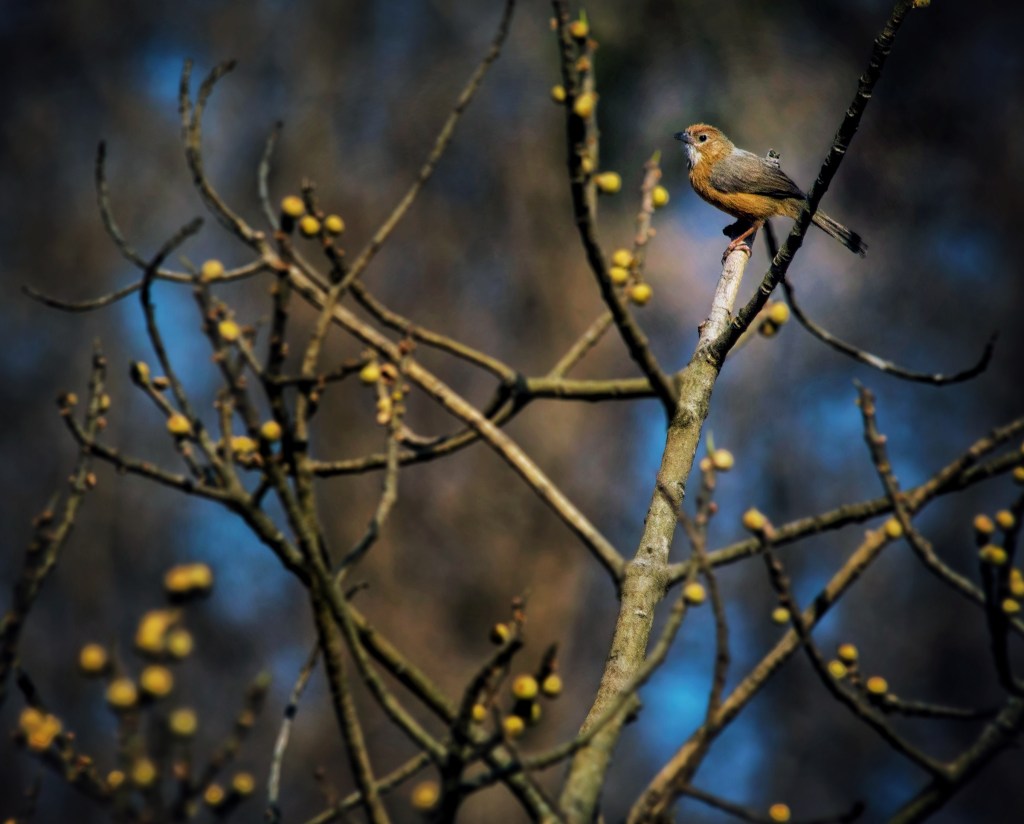
A Tawny Bellied Babbler, an uncommon bird in my region, at The Valley

Birding in dense forests is all about calls and sounds. You can’t see anything except the foliage, yet you hear numerous birds calling. You hear so many birds at the same time that picking up every single call that falls on your ear, distinguishing between them, guessing which bird it might be and then tracking it down is the real challenge. And it’s not just bird calls. Rustling of leaves, footsteps, pecking on the wood, slithering, crawling and anything else that fits under the word ‘sound’. While tracking, leaves look like birds, birds look like leaves, the bird is playing around, jumping from branch to branch, hiding behind the leaves and calling occassionally, thus making things more difficult. This shoots up the excitement, and the happiness when you finally spot the bird is beyond words (also depends on which bird it is, but well :p). It is even more difficult when it’s a ground bird (or an animal), walking on the leaf litter. The location of the bird can be tracked by listening carefully to the crackling of the leaves. But you yourself are standing on the leaf litter, so any movement from your side might just drive the subject away. That’s when patience comes into the picture. You’ve to tactfully trace the subject’s movement and move in that direction keeping in mind other things like whether or not you have something ahead to hide (like a tree, rock etc.), the direction of light (it’s mostly dark deep inside the forest but it does matter sometimes) and other things. This might sound like a five minute task, but it takes a lot more than that, hours sometimes. Any sudden movement from your side and the subject is gone. So you’ve to tip-toe a bit, wait for some time to trace the subject’s movement, check whether or not you can still hear the crackling of the leaves. If not, it might mean that it heard you while you moved and it escaped.

Now when you finally spot the bird/animal you’ve been tracking and start clicking photos, getting good photos deep inside the forest becomes quite difficult due to the lack of light and the dense foliage. Seldom will you see the bird/animal in an open area. Trees, bushes, rocks always make it a point to obstruct your view from time to time. And you cannot change your position much because you’re in the line of sight of the subject and exposing yourself can result in the subject running away. So all this takes a lot of effort and a good presence of mind.Frankly speaking, this is very exciting and to me, this is what true birding or a true wildlife outing is. Doesn’t matter if I don’t get good photos, getting such a lovely on-field experience is all that matters 🙂
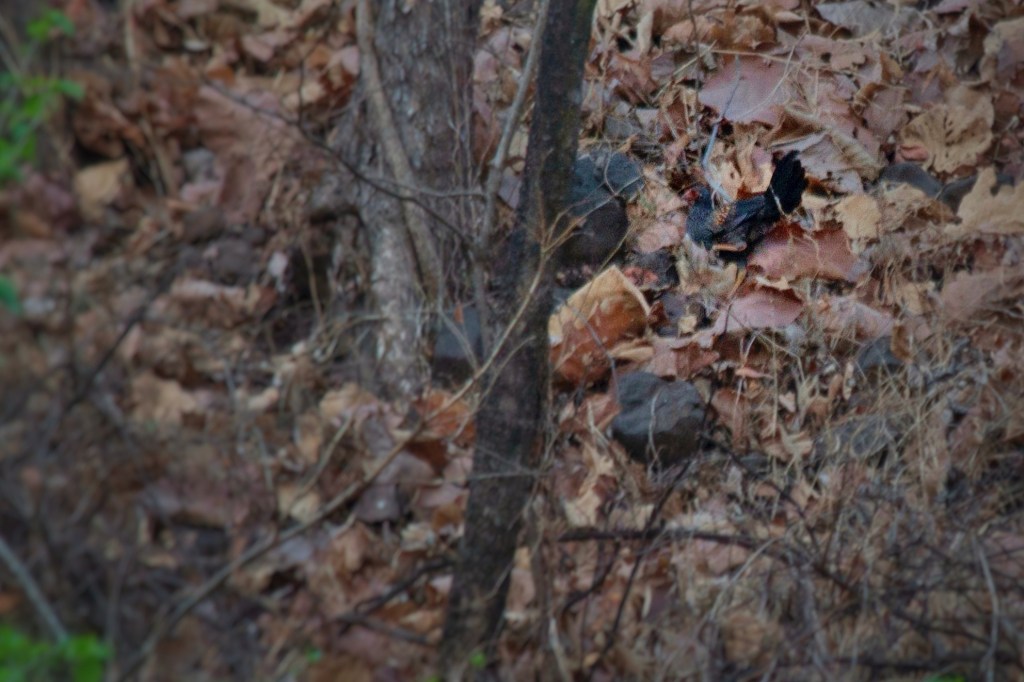
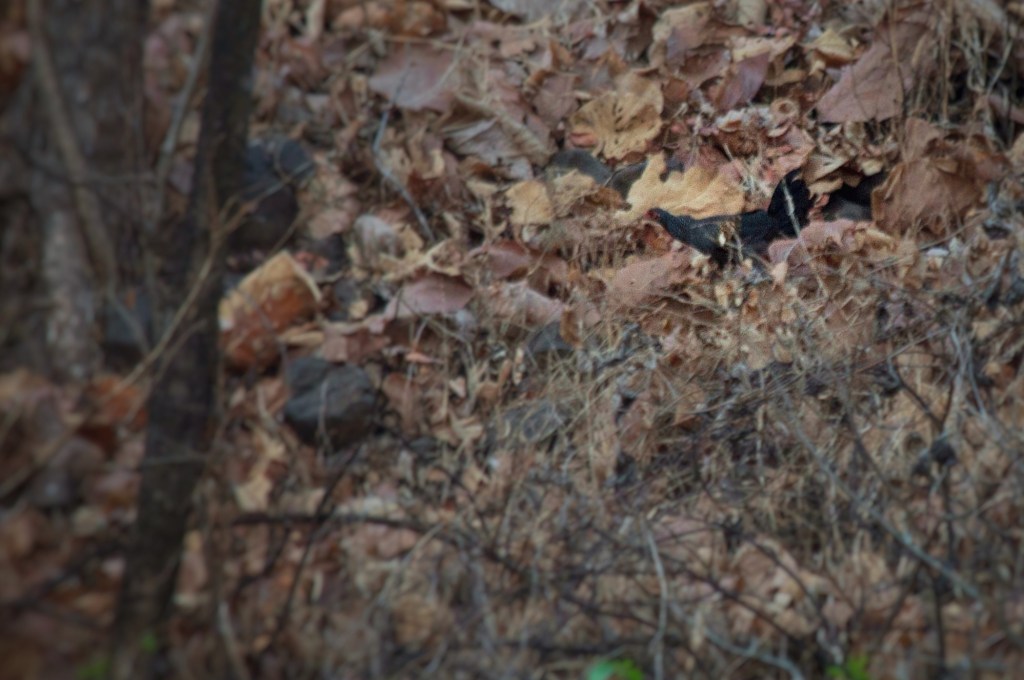
These photos above were clicked during one such outing in the forests of The Valley. There were 4-5 ‘Grey Junglefowls’ on the opposite patch of the forest from where I was standing and they seemed to be in a hurry. I could hear crackling of the leaves but didn’t know who it was and thought it was a ‘Barking deer’. I tried to locate it and to my surprise, I saw a small bird running through the leaf litter. Then came four more. Locating them through the finder was difficult as they were far away. Clicked a few photos but couldn’t keep track of one single individual continuously as there were millions of obstructions. When I went through the photos later, I myself couldn’t find the bird in 2-3 photos :p . Got a few records though. Now I know these photos aren’t great, but it’s the experience and the story that makes them so special. 

Crimson Marsh Glider from The Valley

The Valley isn’t just rich in bird life. It has a very diverse flora and fauna. It was one fine day when we just set out to explore the woods, not knowing the trail. We just took some random paths which led us here. This patch of the forest was totally different than what I had seen all the way, it didn’t seem like a continuation of the same forest. The vegetation, the way of growth of the plants seemed somewhat like that of a rainforest whereas these forests are actually deciduous forests. It was magical, like the ones we see in Hollywood movies. We were observing some birds when suddenly we heard loud barks from a close distance behind our backs. Something came running down the mountain slopes, barking loudly. And it wasn’t just one creature, there were two different loud calls in a chorus. I was literally scared to death for a moment as this happened very suddenly. I thought there were two domestic yet wild dogs running down the hill. It was terrifying as such dogs can be dangerous. I immediately turned around and to my surprise, there were two Barking Deer coming down the hill slopes, one of them being a fawn. It was probably the first time I heard the calls of a Barking Deer, precisely living upto the name of the deer. Soon, the Deer disappeared in the woods. Couldn’t get any photos as it was a very short-lived yet a lovely sight. 

A Fulvous Forest Skimmer in The Valley

The stories from The Valley can go on and on, there is so much to share! Gonna make one final (probably) blog about the tales from The Valley after this one, maybe in the next week. Stay tuned 🙂

Also, I recorded the drumming sound, or the sound of a woodpecker pecking on a tree bark one morning deep inside the forests of The Valley. Since we talked about the importance of listening to all types of sounds, soft and loud, while birding in forests in order to track the birds and animals, listen to this soft drumming sound to at least get a slight feel of the forests(listen to it closely). We tracked this woodpecker for a long long time by listening to its calls and the drumming sound just to get a glimpse of it at the end. It wasn’t open in our sight for even 5 minutes straight!

I’m not able to upload the video here so I’ve uploaded it on my Drive, click on this link here to listen to the Drumming sounds- https://drive.google.com/open?id=1ALAEwB526ywP–KUYfCSeYdlnP6tjRs6
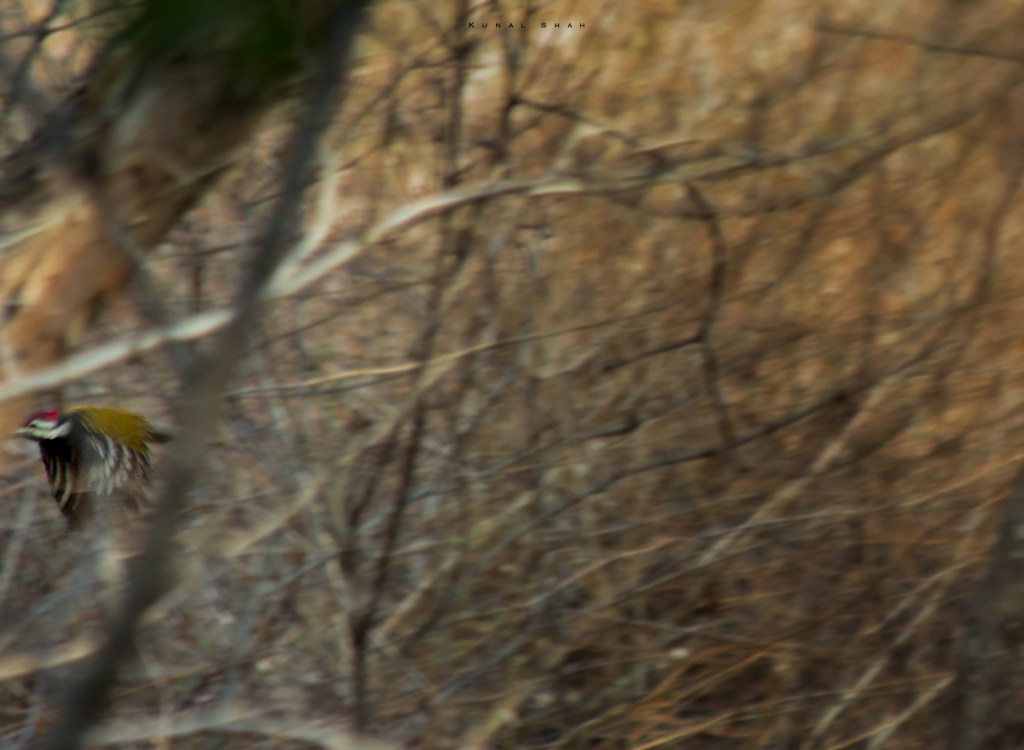
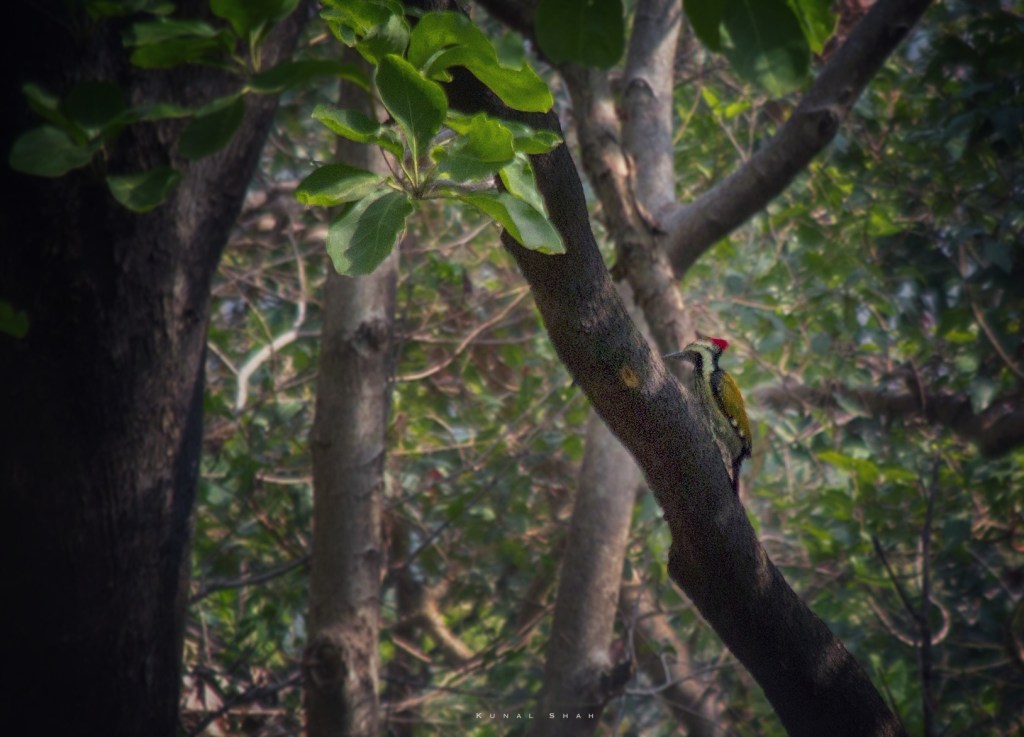
Record shots of an uncommon woodpecker from my region, Lesser Flameback, at The Valley

This is a 3-part blog and you just read Part 2. You can read Part 1 here, to establish more connection to The Valley-

https://kswild.video.blog/2019/12/25/the-valley/

If you’ve already read it, great, you can move to the next and the final part of this series, to continue your adventures in The Valley-

https://kswild.video.blog/2020/02/13/birding-in-the-valley-part-2/

The Valley

A single rabbit track in the field leading to the dense forest ahead, in Winter during sunrise

Ah this place! Being at the outskirts of the city, it still is an integral part of the city as many people like to visit this place on weekends. Almost everybody who go there goes for a hike in the mountains. But what most don’t know is the beautiful habitat of The Valley of those mountains. The Valley, one of my favourite spots around Pune city for an outing.Boarding the 5.30 am bus, reaching this place at pitch darkness, before sunrise, waiting at a small local food stop or ‘tapri’ with a Woof family for the sun to throw some light in the sky, while being all ears to the Nightjar calls, the cock-a-doodle-doo, maybe owl calls sometimes, is so thrilling. Walking a 5 minutes walk just to glance over the stream and then heading straight to the fields ahead to witness the first sight of the day’s sun is the next thing I would do as soon as there is some sign of light in the sky! And THAT is my favourite part, walking in THAT particular field when the sun just peeks from behind the mountains at the front, throwing golden light in the sky with alternate clouds which add up to the beauty. The birds chirping, occasional calls of the Barking Deer, there shoots a Pipit in the sky, the light falling part by part on the mountains to the right, the beautiful, small green thorny plants with yellow flowers all around with a single rabbit track at the centre of the field. Such a bliss♥️ This is what I live for! What place is this? A five star hotel? A grand shopping mall? It’s just a simple field. A field surrounded by mountains on three sides, a place where you can witness such beautiful sunrises, a single track leading to the lovely, dense forests with inviting whistles of the Common Iora echoing through The Valley, a Serpent Eagle wishing Good Morning from the top of the mountain through its endless Kwiiii-Kwiu-Kwiu screams. This is what Sinhagad Valley is all about! 

By the time the Sun climbs up a suitable height in the sky to light up the entire place and make the environment warm enough without throwing harsh heat waves at you, you wake up completely from your early morning sleep. It’s still 8am on the clock and you have a lot of time to explore. This is when I head towards the forests ahead. This forest has one of the most beautiful vegetation around Pune. People do not explore this forest much because what people here think of when I say ‘The Valley’ is the stream that flows before the fields. This stream is the major attraction for all the bird photographers in Pune. Almost no one will ever talk about the fields and the forests ahead. Of course, why would they?

The field and the mountains to it’s right, in Monsoons at around 8 am

This stream is one such place that come what may, you’ll get to see a variety of birds from a VERY close distance during the right season.You literally need no efforts to get good photos, the place where the bird sits is also pre decided, you just have to have a tripod aimed towards that spot and a 600mm ready (I don’t even have a 600mm lol), that’s it, you’re sure to get each and every feather of the bird sharp in your photo. Literally anyone who has even 2% skill can do this. And that’s why this place is always crowded, come here during this season and there will definitely be a crowd of 10-15+ people sitting around this very small stream, even on odd days. Sundays are a bonus, 30+ people sure, no breathing room and the stream turns into a chat room with everyone trying to show their ‘expertise’. During the rest of the year, there won’t be even 3 people around the entire area including the fields and forest ahead, naturally because the stream is dry so you won’t get readymade sightings. Getting good sightings and photos in the jungle ahead is not at all easy.

Well I’m not that person who’ll enjoy such ‘readymade’ photos where there is no satisfaction of ‘making’ the photo, I’d rather prefer to get less beautiful photos but explore. Though there is nothing wrong in sitting by the stream, what I don’t like is the crowding behaviour of people. That is completely wrong I’ll say. It causes a lot of disturbance to the natural activity of birds. And people will do anything to get good photos. They won’t follow the wildlife ethics, they’ll set up artificial perches for the birds, they’ll keep baits, they’ll create artificial ponds and what not. Theres no point in getting such ‘readymade’ photos, where everyone has literally the exact same photos. Also, this is not what I call birding. Birding for me is exploring on foot, finding new habitats, approaching birds without disturbing them while still maintaining suitable distance and following ethics. That’s why I love the forests of the Valley so much as they provide an amazing experience every time. 

There’s a lot that I have to tell about finding wildlife in The Valley and my experiences from The Valley. I will publish another blog next week narrating the same.  Because, however the journey ahead is, be it with a lot of sightings or even on a duck at times, I never get bored of this place and never can I ever get enough of the jungle and the sunrise through my favourite, photospot-ic field! Stay tuned 🙂

This is a 3-part blog and you just read Part 1. Read the next part here, where the adventure at The Valley actually begins-

https://kswild.video.blog/2020/01/09/birding-in-the-valley-part-1/

If you’ve already started your adventures in Part 2, you can skip to Part 3 here, to continue your adventures in The Valley-

https://kswild.video.blog/2020/02/13/birding-in-the-valley-part-2/

Call of The Wild

A silhouette of a Crested Hawk Eagle from Pench

I’m sure, most of you haven’t seen something like this before. A very rare event to be witnessed in wild!
It was three years ago at a forest in Central India called Pench. 

8.20 pm, night time. We were in the middle of the forest surrounded by dry, bare trees and a number of wild animals. There was hardly anything visible in the moonlight even though it was a full moon. We were under the sea of millions of stars along with Jupiter, Mars and Saturn shining bright. The silence was dreadful, except a few calls of Nightjars. That was THE day(night :p) when I actually experienced the Sound of Silence. I could hear my ears ringing. It was a nice and an unique experience, listening to the sound of silence in raw wilderness. It was a bit scary as well. Suddenly, we saw a pair of shiny, fiery eyes in a patch of dense trees under the torchlight. Then came 2-3 more pairs. We went closer and to our surprise, we saw an entire pack of wolves. 
One wolf was resting right in front of us. The rest of the pack was hiding behind the trees and some of the individuals were scattered all around. All of a sudden the howling started. He got up immediately and went to his pack and joined the choir and the entire forest started echoing with howls in a chorus. We all were speechless, literally spellbound for a second. It was terrifying and amusing at the same time to witness this from such close quarters. Totally unexpected. While the party was going on, I heard a slight crackling of dried leaves behind me. When I turned around, I saw a wolf running in our direction! I was scared stiffstar! But it changed its direction and vanished into the bushes. Then we saw wolves running all over the place.It was a huge pack with around 14 individuals. Usually wolves roam in a pack of 6-8. It was truly a great experience! After sometime, we decided to leave them alone and turned around. We all were contended having able to see this! 
This incident has been etched in my mind forever and I can still live the moment in my mind when I think about it. It truly is rare to be able to witness this in the wild and I’m really lucky to have experienced this 🙂

Do you know why Wolves howl?
There are many animals that howl. The most famous howler is the wolf. Animals howl for various reasons. There are three main reasons, why a wolf howls-
One is to communicate to other wolf packs that they’ve taken this territory and better stay away(territorial marking). Wolves also howl to find their pack members and bring them together (as seen in the attached video). The howls of wolves can be heard over miles! The third reason is for social purposes such as maintaining relationships with the pack. It is seen that during the denning season, the howling of wolves drops as they want to avoid giving the dens location to other animals. 

Why am I calling this as a rare event?
The howling of Indian Grey Wolves is no doubt a rare event! Indian Grey Wolves are known to howl very rarely, comparatively. Maybe because they are not as territorial as the other species.
——————————
Also, have you read The Jungle Book? Did you love it as a child? Do you still love it? Well, the forest that I was talking about here is the very same forest where The Jungle Book took place. Yes! It is a true story! Maybe not the exact ‘story’ as such, just the idea or the inspiration. We don’t know that, Kipling knows :p
It was during the rule of the British East India Company over India when they came across a boy living with a pack of wolves in the forests around the village Seoni. They informed this to the writer Rudyard Kipling who had never  ever been to India. He found inspiration in this and wrote the famous ‘The Jungle Book’. 
The village Seoni still exists at the forest Pench in Central India. It even has a mention in the book. Interesting, isn’t it? 
——————————-
Coming back to the story, as it was completely dark, I couldn’t click any photos of the incidence. However my mind luckily made the decision to shoot a video instead. I have attached the video here, do watch. Remember to turn up the volume to the highest, or even better, use headphones. If you have pets around, especially dogs, they might go wild on hearing the howls so beware :p

(Couldn’t upload the video directly for “Security Reasons” of WordPress apparently so adding a link, do watch! 🙂
——————————-
Indian Grey Wolf (Cannis lupus Pallipes)

Link of the Howling Wolves video-

https://drive.google.com/file/d/1mN1DRXCJWPcfzBUdiaC4ZI8vBRCT2sf6/view?usp=sharing

Design a site like this with WordPress.com
Get started