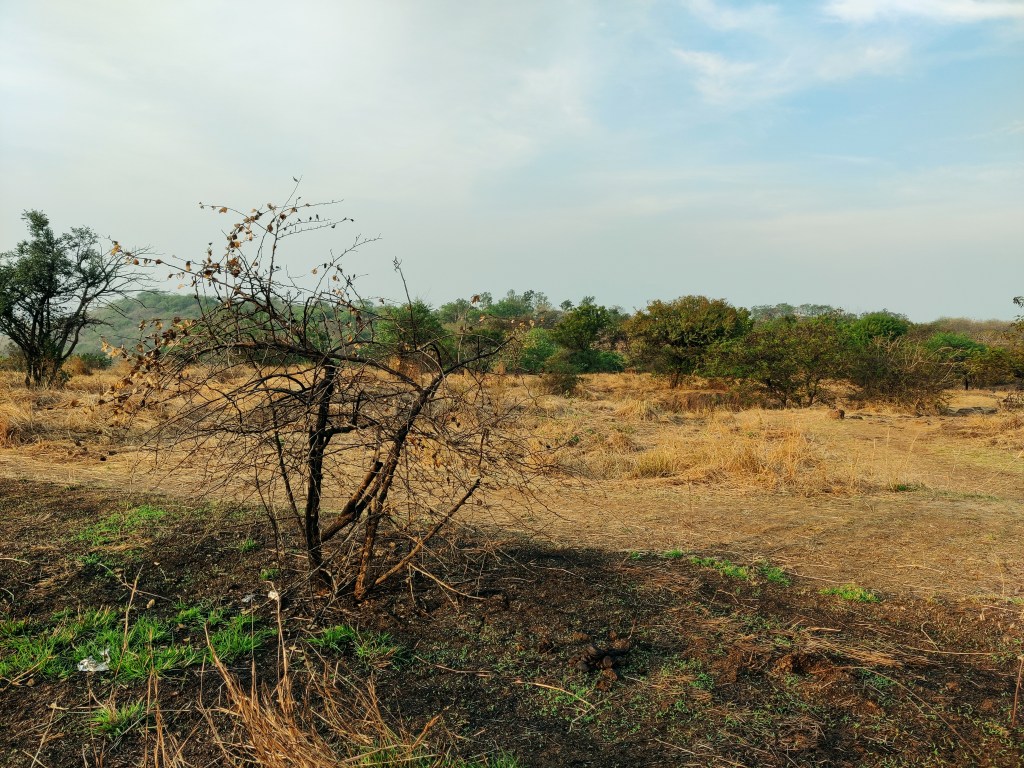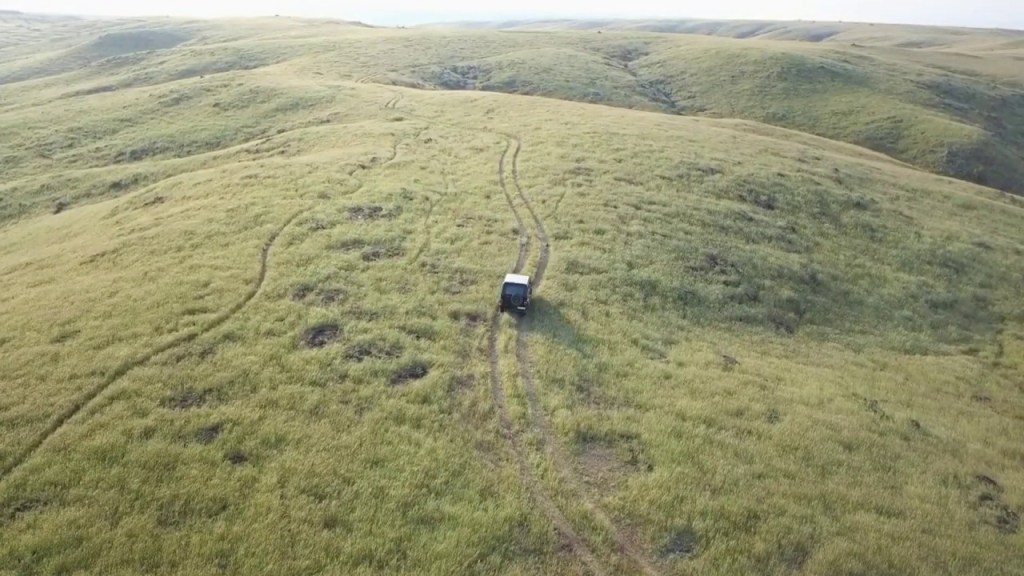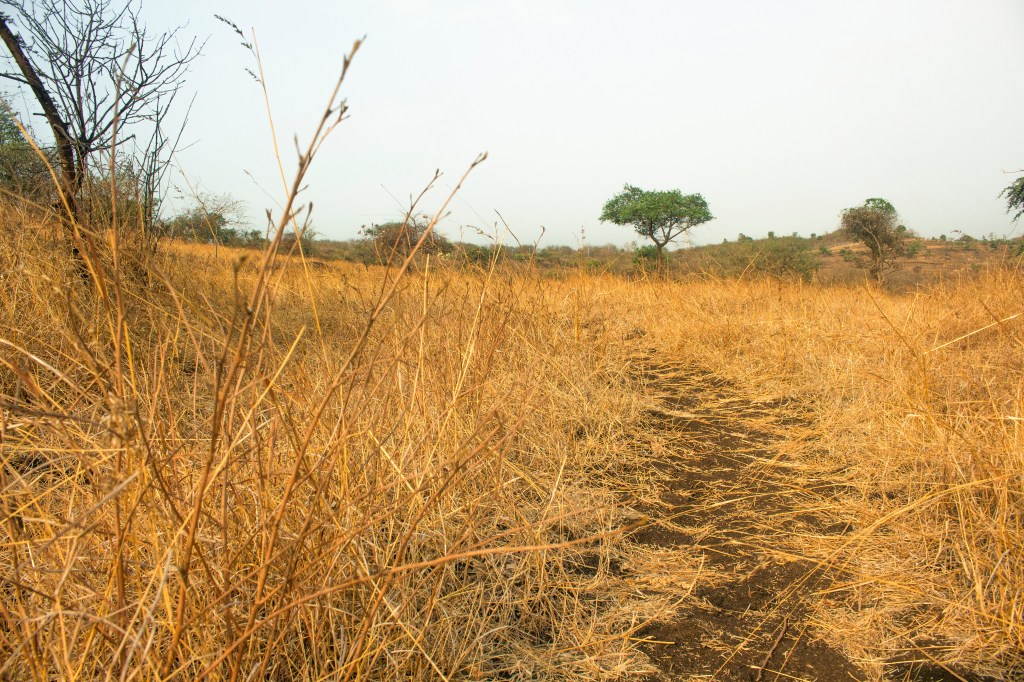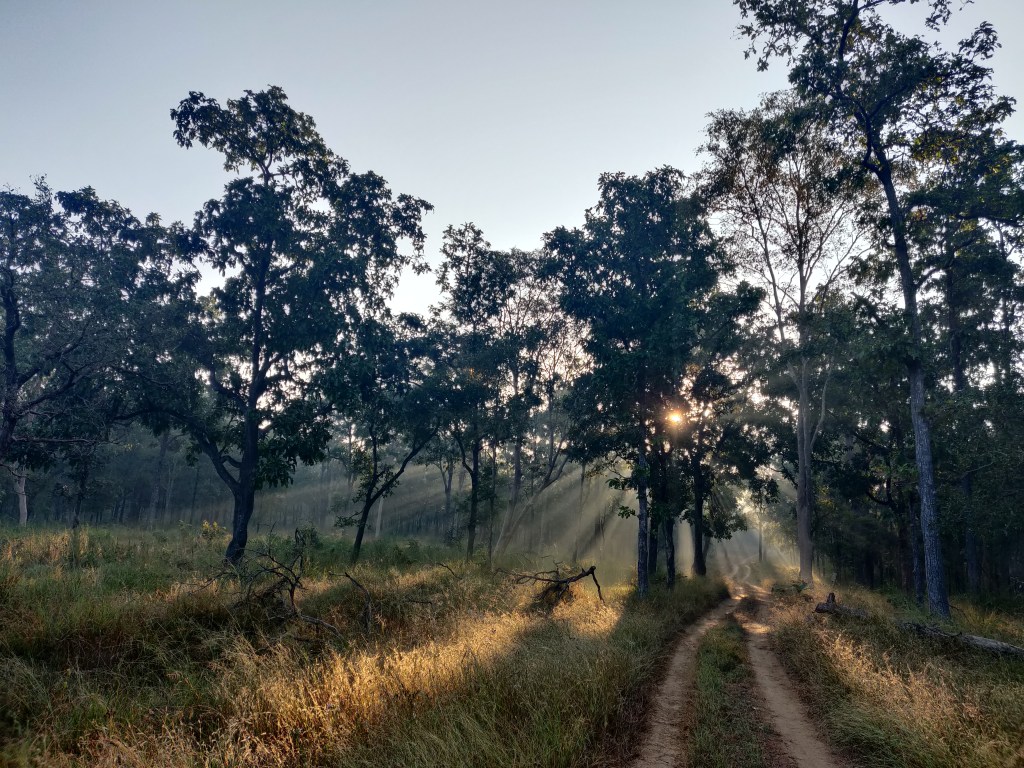
Are Forest fires really bad?

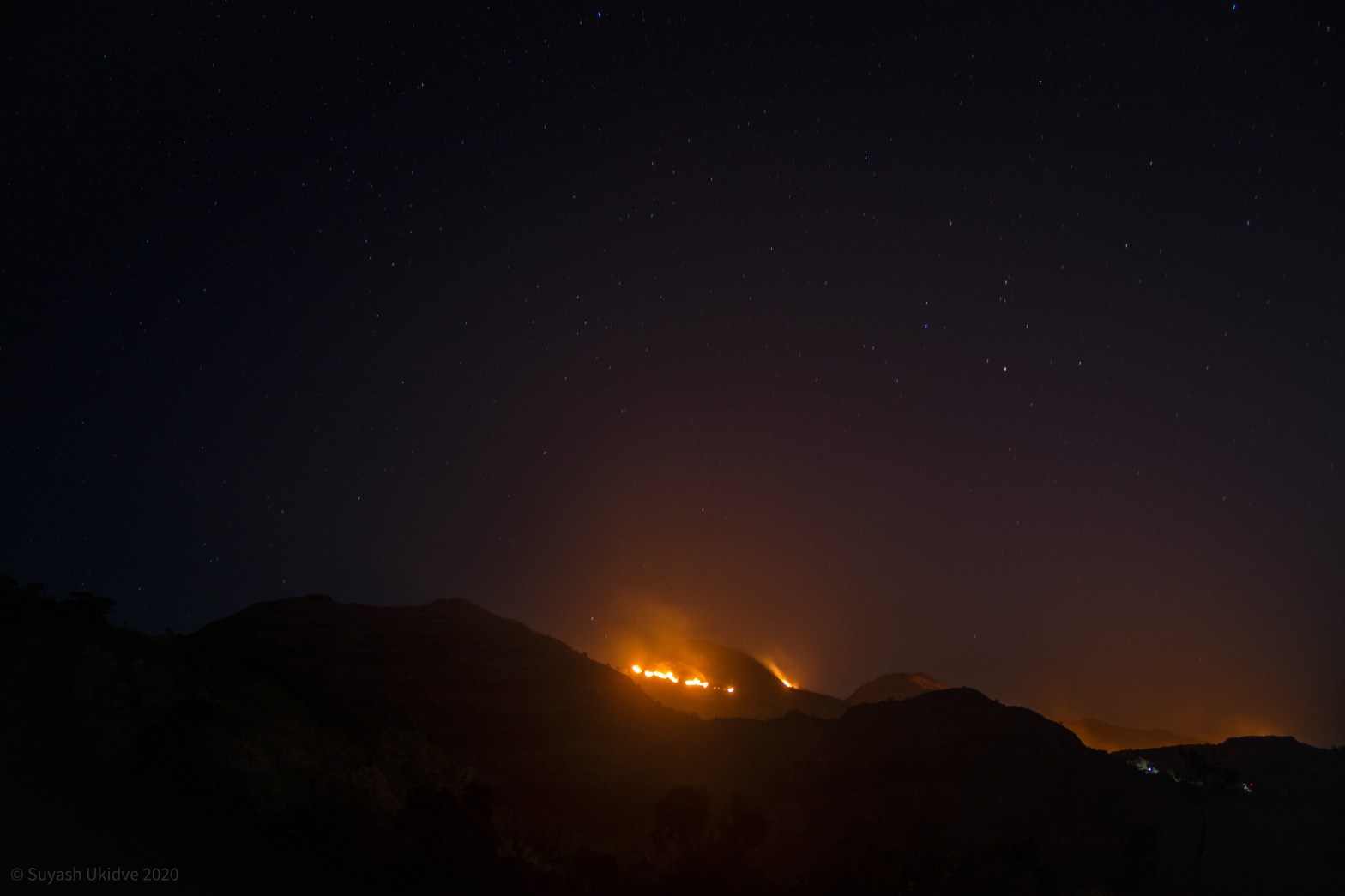
Photo by Suyash Ukidve

As we are now in the dry season of the year, news will start pouring in about forest fires in different parts of India. This is an every year story when there is some or the other fire in the months of November to May, in some part of the country. Forest fires are horrible, they totally disrupt the ecosystem and all the life there- this is what we’ve been seeing in the news and learning since our childhood. Is this entirely true though? Or is it just a misunderstanding? 

Now you might be thinking, how can something so evident be a misunderstanding? We can literally see everything burning down to ashes! Well, this is what this blog is about. Research says that we’ve been looking at Forest Fires all wrong and this is what we’ll be discussing in this blog. 

Note that whatever you’ll be reading in this blog will probably be totally contradictory to whatever we all have been learning since childhood or seeing all over the media. Also note that these are not my own opinions or thoughts but actual research carried out by ecologists. Even if you’re not a nature geek, it won’t be boring and you’ll be learning something totally new (and maybe surprising), so keep going!

A very important thing before we get started- make sure you’ve read my previous blog called “Savannahs, in India?” This blog would make complete sense to you ONLY if you’ve read that blog. So go check it out first, if you haven’t already- https://kswild.video.blog/2021/01/14/savannahs-in-india/

Assuming that you’ve all read my previous blog, let’s get started.

It is believed that forest fires came into existence only when humans started using fire. However, a common source of fire that we often ignore is lightning. Lightning has been causing fires since almost the past 10 million years, even before humans first used it. Fires have been shaping India’s landscape since ages. In India, fires have been most active in our Savannahs(now you know what regions I’m talking about, this is what we discussed in the last blog). Indian Savannahs as well as Savannahs all over the world have evolved with regular fires since millions of years.

The indigenous people of India have long used (and still do) fire as an essential land management tool. Among many other reasons, they burnt off the grasslands in the dry season to promote the growth of fresh fodder for their livestock. These practices were carried out since ancient times, which benefited both the ecosystem as well as the people who co-existed there. However, this traditional knowledge of the people was at odds with the colonial view. As we discussed in the last blog, the Britishers were only interested in Timber and other such forest extracts- basically trees, and how they had classified the Indian Savannahs into either Deciduous Forests or Wastelands. Fires hinder the tree growth by top killing trees and promoting grasses. The colonial foresters were trained in western silvicultural practices where fire indeed proved to be destructive for tree growth. They applied the same assumptions in India and banned all the traditional fire regimes of the locals. This belief of all fires are bad was carried forward post independence and all fires were declared as illegal in the constitution. The 50,000 year old tradition of controlled burning was forgotten.

This was the historical point of view of why we in India view fires as bad, even though they have been prevalent in the subcontinent since ever and have played a crucial role in the shaping of our landscape. It is interesting to note that in many other countries, Savannahs are burnt regularly- the Prairies of the USA, the Australian Eucalypt Savannahs and even the African Savannahs burn. 

Forest fires or Savannah fires?

The term ‘Forest Fires’ is problematic. In the last blog, we discussed how forests are different from Savannahs and how we’ve got Savannahs in almost the entire Indian peninsular region. When there is a fire in a forest, it indeed is destructive and destroys forest biodiversity that is typically not adapted to fires. So in that sense, Forest Fires are not at all desirable and need to be stopped. For example, the Amazon Fires are undesirable and so are fires in Mahabaleshwar. However, we do need regular fires in Savannahs. That’s the catch! Referring to Savannahs as Forests changes the management perspectives as both are different ecosystems. Fires in Savannahs shouldn’t be called ‘Forest Fires’. Let’s call them ‘Savannah Fires’ instead.

So, let us now discuss the importance of fires and why even today, we need regular Savannah Fires. 

As the Savannahs have evolved with regular fires since the past 10 million years, the plants that belong to this ecosystem have also evolved and adapted to the fire. Typical Savannah plant species are like icebergs- there’s much more to them under the ground than what we see just on the surface. They have a large chain of roots and organs under the ground that have developed over ages. Savannah species are very prone to fires as they store volatile oils in them that promote fires during the dry season. In the event of a fire, everything on the surface burns off, but the plants are very much alive under the ground as soil is a very good insulator. The fires clear off the surface making space for new growth, which helps the plants to re-sprout immediately. In fact, there are many Savannah species that depend on the heat of the fire to re-sprout, in the absence of which they wouldn’t grow. Fires also activate the dormant seeds underground to germinate. This is how the Savannahs are dependent on regular fires.
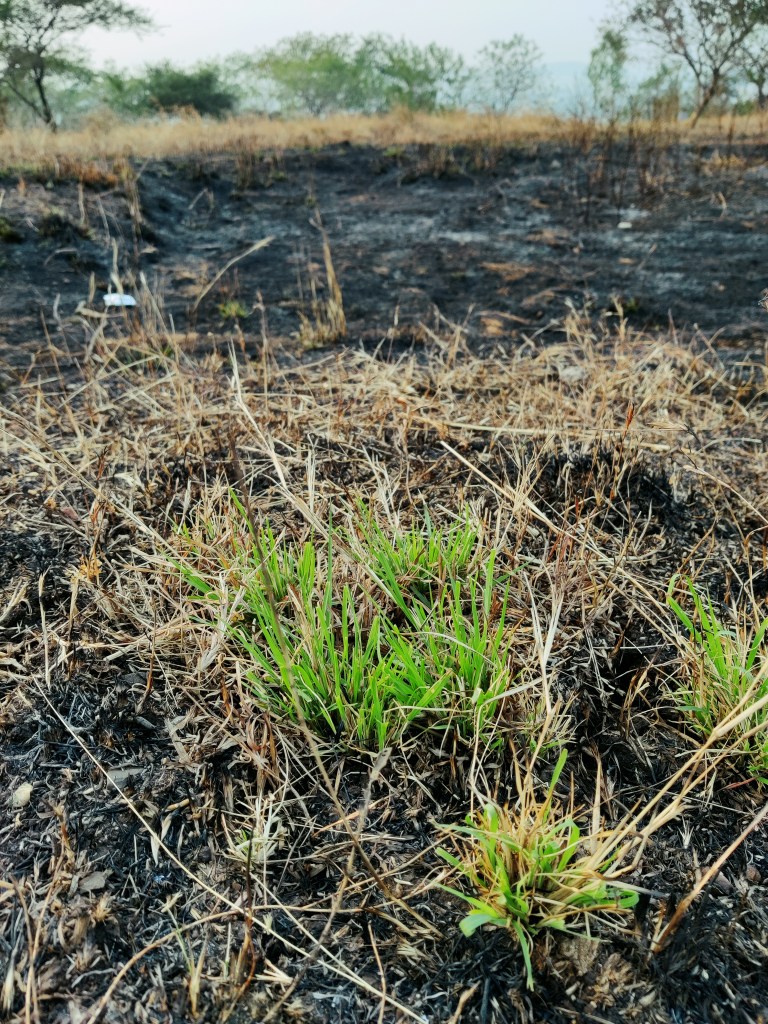
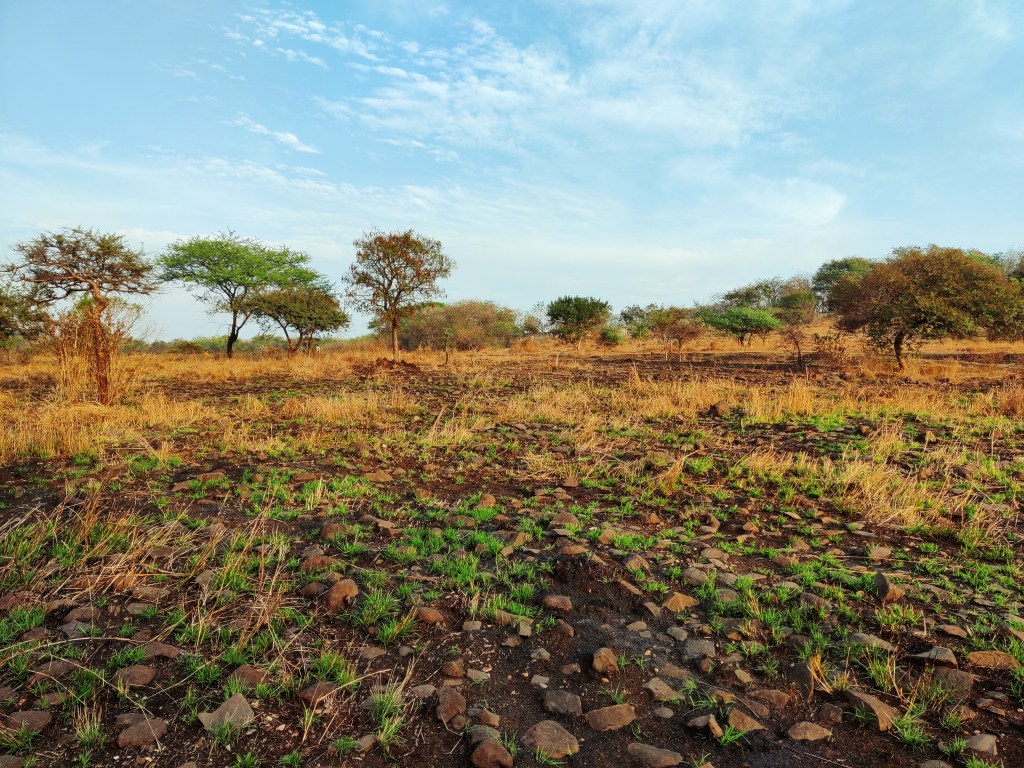
(1) Regrowth of fresh vegetation after burning of a small patch, just in a weeks time. (2) 3 weeks after burning

As we discussed in the previous blog, Savannahs have an open canopy that allows the growth of grassy species on the ground. In an event of dense trees growing and closing the canopy, the grassy understory would die resulting in the extinction of several species. Fires keep a check on this and do not allow woody encroachment in the Savannahs. The woody plants of the Savannahs have also evolved with the regular fires. They have a much thicker bark than forest trees to survive fires. During fires, these trees do not die, but fires don’t allow them to grow very tall as well as propagate all over the area, to maintain the open canopy. This mechanism has evolved over millions of years that has been regulating and naturally maintaining our Savannahs. If fires are totally suppressed, there would be woody encroachments all over the Savannahs which will totally change the ecosystem. 
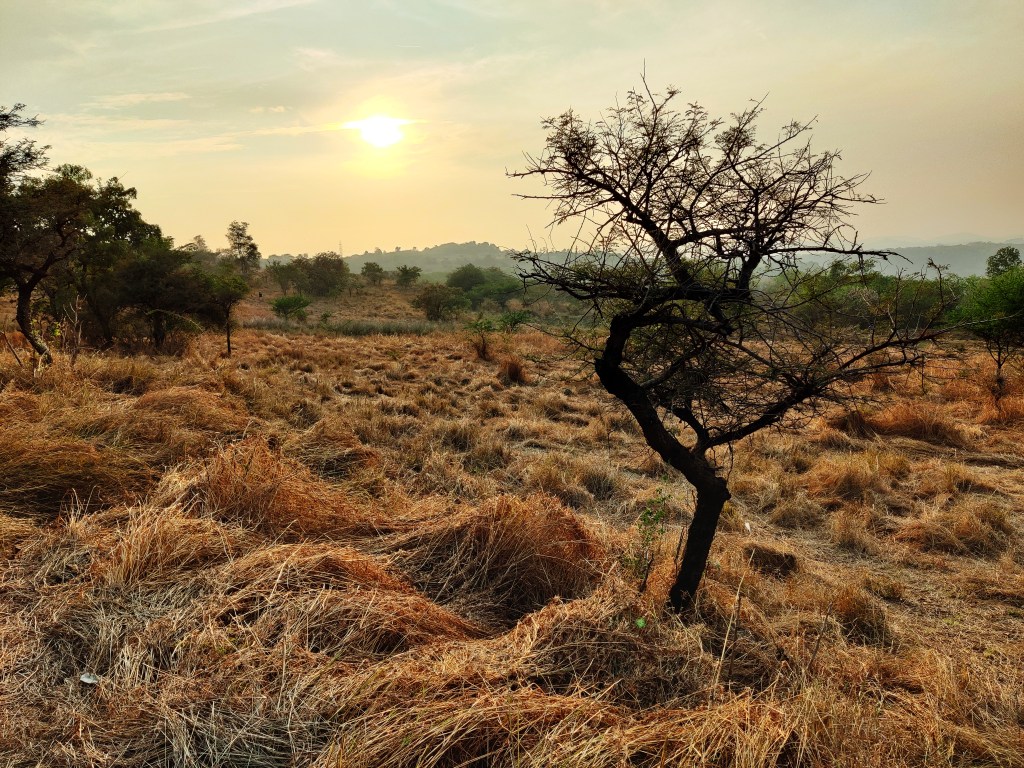
These Acacia trees here are probably 50-100 years+ old, yet they are very short as the fires haven’t allowed them to grow tall

Another important role that fires play is keeping invasive plant species at bay. Take for example the invasive plant Lantana camara. This plant originally belongs to South and Central America but is dominating the Indian landscapes today causing trouble to the native species. Before the Brits arrived, invasive species such as this one were kept under control by regular fires as fires kill these encroaching species. However today as fires are suppressed by the government and are declared as illegal, this invasive plant along with other invasives like Cosmos have dominated the landscape and are proving to be very competitive with the native species. 
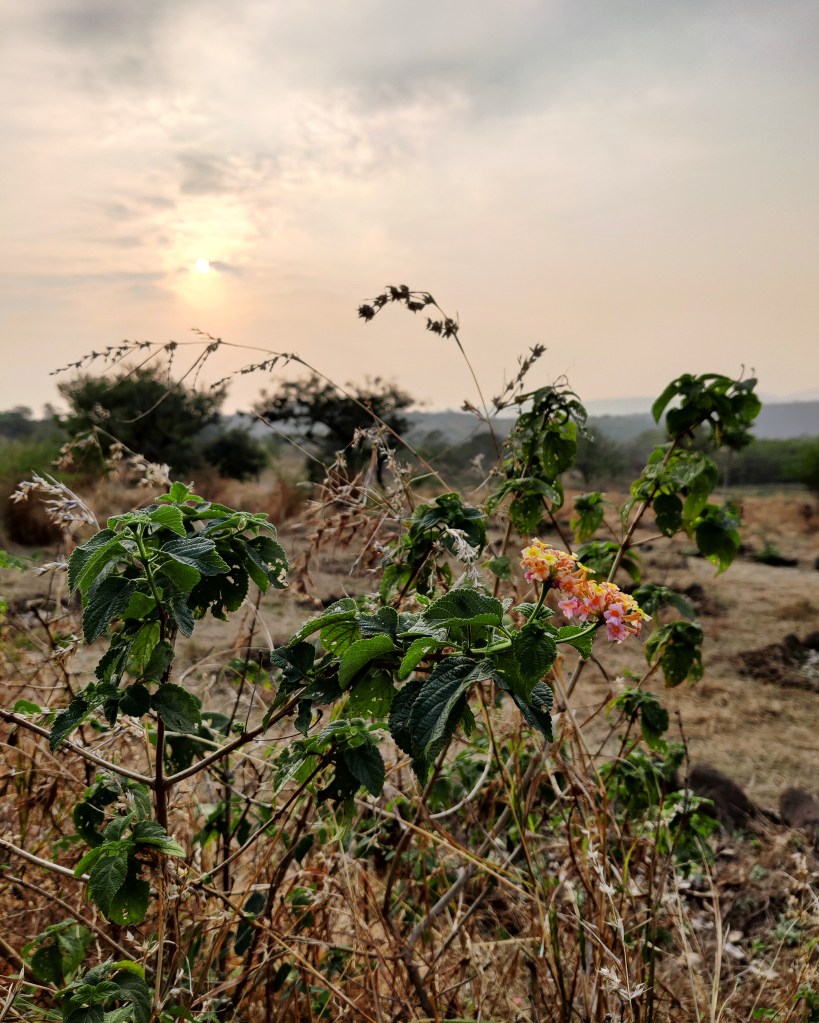
The invasive Lantana camara on the Savannahs of Pune hills

This is why Savannahs even today need regular fires. Let us now understand what will happen if fires are not allowed.

As we discussed earlier, a lot of typical Savannah plant species are dependent on fire for their growth. We’ll lose out on all those plant species if fires are suppressed. Many of the endemic plant species will be lost resulting in the decline of some herbivore species which will directly affect the predatory animals like tigers. Suppression of fires will also allow the growth of invasive plant species and dense wooded trees which will affect the ecosystem and its inhabitants negatively. When there are regular fires in Savannahs, the dead plants get burnt off clearing the land for new growth. The height of this fire is just surface level and can be controlled easily. However if fires are stopped, the dead plants will get accumulated over the years. As these dead plants get accumulated, the fuels just pile up, waiting to get burnt- and they sure will burn one day. But the flames would be so tall that it would be beyond control. This is what we call crown fires. 
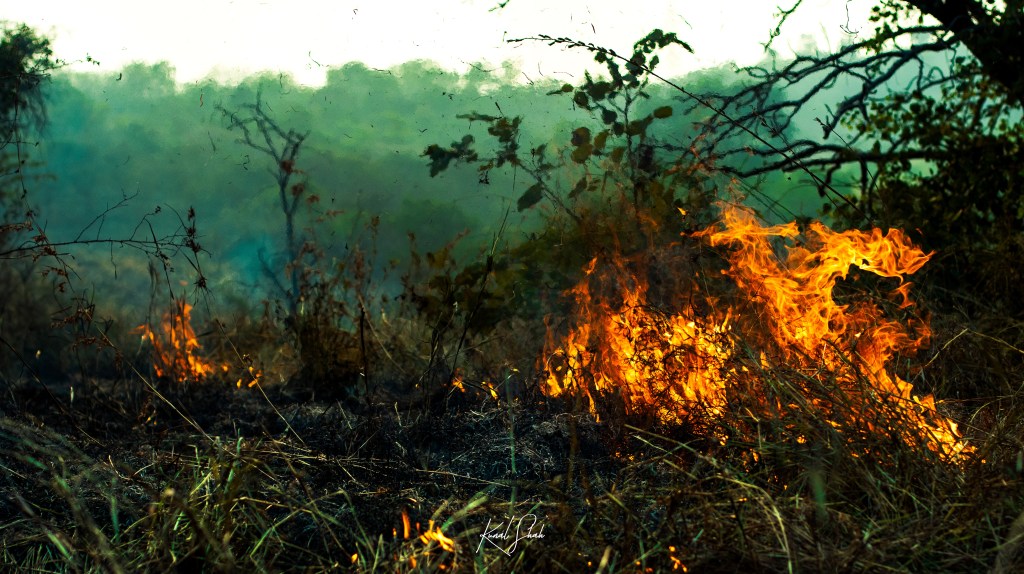
Surface fires on the Savannahs of Pune hills that are burnt regularly

A recent example of huge crown fires in India are the Bandipur fires of 2019. Bandipur National Park is a typical Wooded Savannah region, which is of course wrongly classified as a Deciduous Forest like all the other Wooded Savannahs of India. Since it is a protected region, fires there are totally suppressed by the government. As a result, fuels got accumulated and invasive species like Lantana camara bloomed over the entire region. A massive fire broke in various parts of Bandipur in 2019 which got out of control, burning the entire Savannah. Events like these can be easily avoided by letting the region burn periodically.

What happens to the animals of the Savannah when it burns?

Like the plants, the Savannah animals too have adapted to the fires since millenia. The animals that we see in Savannahs are typical Savannah animals that can only survive there and have been evolving with the ecosystem and the fires over ages. The fires don’t harm them at all as they have their own survival strategies. The reptiles and amphibians can burrow and the birds and mammals can flee to some other unburnt area till the fires cool off (since fires are typically patchy). If fires were to kill these animals, we would not see such a vast diversity of endemic Savannah animals today. And not to forget that the fresh forage after the fires supports many herbivores.

What about the Carbon dioxide that these fires release?

Fires of course release Carbon dioxide in the atmosphere. But in the long term, Savannahs as an ecosystem store far more carbon than they emit. That is, Savannahs are a net carbon sink. We all know that forests play a huge role in Carbon sequestration. However, what most people are not aware of is that Savannahs also play a huge role as carbon sinks, even though they might look barren to us. Savannah plant species store a huge amount of Carbon in their underground organs and are equally important Carbon sinks as are forests. Also, the ash and char that is left behind after burning is essentially carbon that gets mixed up with the soil- an under appreciated carbon sequestration process. 

If Savannahs used to burn naturally in ancient times, why do people burn them themselves, now? Isn’t that human intervention?

Savannahs have been burning on their own since ancient times. Even today, a significant number of fires in Savannahs all over the world including India are started by lightning. As humans evolved, they changed the landscape with them. Earlier, there were long, continuous, uninterrupted stretches of Savannahs that used to burn entirely even when a small fire started. But as humans evolved, these long patches got fragmented. Even a small rabbit track through the Savannah is enough to stop the spread of fire. In India, there are fragmented patches of Savannahs in urban cities or around villages, the hills in Pune city for example. These patches cannot burn entirely as the continuity of the Savannahs is broken due to many reasons. Therefore, burning these patches manually in a controlled environment is necessary. Infact, Savannahs worldwide are burnt regularly by the means of ‘Prescribed Fires’. Prescribed Fires are the fires that are set in the Savannahs with a clear management goal (eg. fresh forage) after carrying out a detailed study of the weather, the winds, the vastness of the area and some other factors before setting a fire. That way, the Savannahs are burnt in patches, in a controlled environment. That’s how the locals of Indian Savannahs have been burning them since ages. 
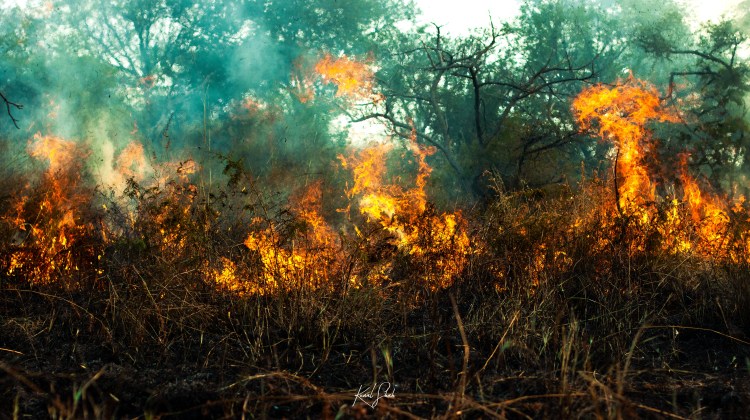
Controlled burning on the hills of Pune city- which are Savannahs

How often do Savannahs need to burn?

There’s no one answer to this. It depends from region to region. Some Savannahs need to burn more frequently than the others. The goal should be to meet the ‘natural’ burning frequency of the particular Savannahs like it was millions of years ago. The associated  biodiversity of these Savannahs has evolved with this historical fire frequency and any drastic changes to this will typically have negative effects on the native biodiversity. Over burning is not good, under burning/not burning is even bad. More research needs to be carried out from region to region to plan proper fire regimes. 

Now that we know that Savannahs need to burn, do we just go out and burn them?

No, not at all. As we discussed, to burn a particular patch of a Savannah a lot of research has to be carried out beforehand- what we call ‘Prescribed Fires’. Only the people trained in Prescribed Fires should be permitted legally to burn the Savannahs. This also includes indeginous people who have such training, though in an informal way. Burning the Savannahs is not something that we do for fun, a lot can go wrong if it is not done carefully. 

So to conclude, it is important for us to understand that Savannahs have evolved with regular fires over millions of years and fires are an integral part of the Savannah ecosystem. Stopping these fires will negatively affect this ecosystem and all its inhabitants. To keep the Savannahs as they are and to protect this unique ecosystem, allowing them to burn is essential. However, the government has declared fires as illegal in the country, especially in all the constitutionally protected regions like national parks and sanctuaries. As we discussed in the previous blog, many of these regions are essentially Savannahs even though they are wrongly classified as Deciduous Forests. The government spends huge amounts to suppress fires all over the country. This has been changing the Savannah ecosystems drastically. There have been a lot of woody encroachments and invasion of foreign plants, especially Lantana camara and we’ve also lost many of our Savannah endemics. Our government is ready to spend a huge amount of money to remove Lantana, but a simple answer to this is allowing fires to do their job. Fires have been widely misunderstood and today we even have sufficient research to prove that we need to allow regular fires in our Indian Savannahs. It’s high time we realise that and normalise fires as well as change our plan of action. As it is popularly said, if you do not burn the Savannahs, they will burn themselves. 

———————————————————————-

Thank you for sticking to the end, hope you learnt something new. Thanks a lot to my friend Ashish Nerlekar for his help with this blog.

As always, you can get in touch with me if you have any queries or want to have a discussion. Just comment below or DM me on Instagram ‘@ks_wild’ and I’ll get back to you.

———————————————————————-

Here are some references that you can go through to get a deeper insight about the importance of fires in the Indian Landscape :

  1. An article about the fires in India- https://www.researchgate.net/publication/318122947_Notes_from_the_Other_Side_of_a_Forest_Fire-
  2. Bandipur Megafire 2019- https://scroll.in/article/916442/indias-understanding-of-forest-fires-has-been-skewed-by-colonial-era-policy
  3. https://www.thehindu.com/sci-tech/energy-and-environment/fires-are-a-crucial-component-of-some-forest-systems-says-group-of-scientists/article26431398.ece
  4. A talk on Fires in the Indian Landscape- https://www.instagram.com/tv/CBUma5yAFxw/…
Savannahs, in India?

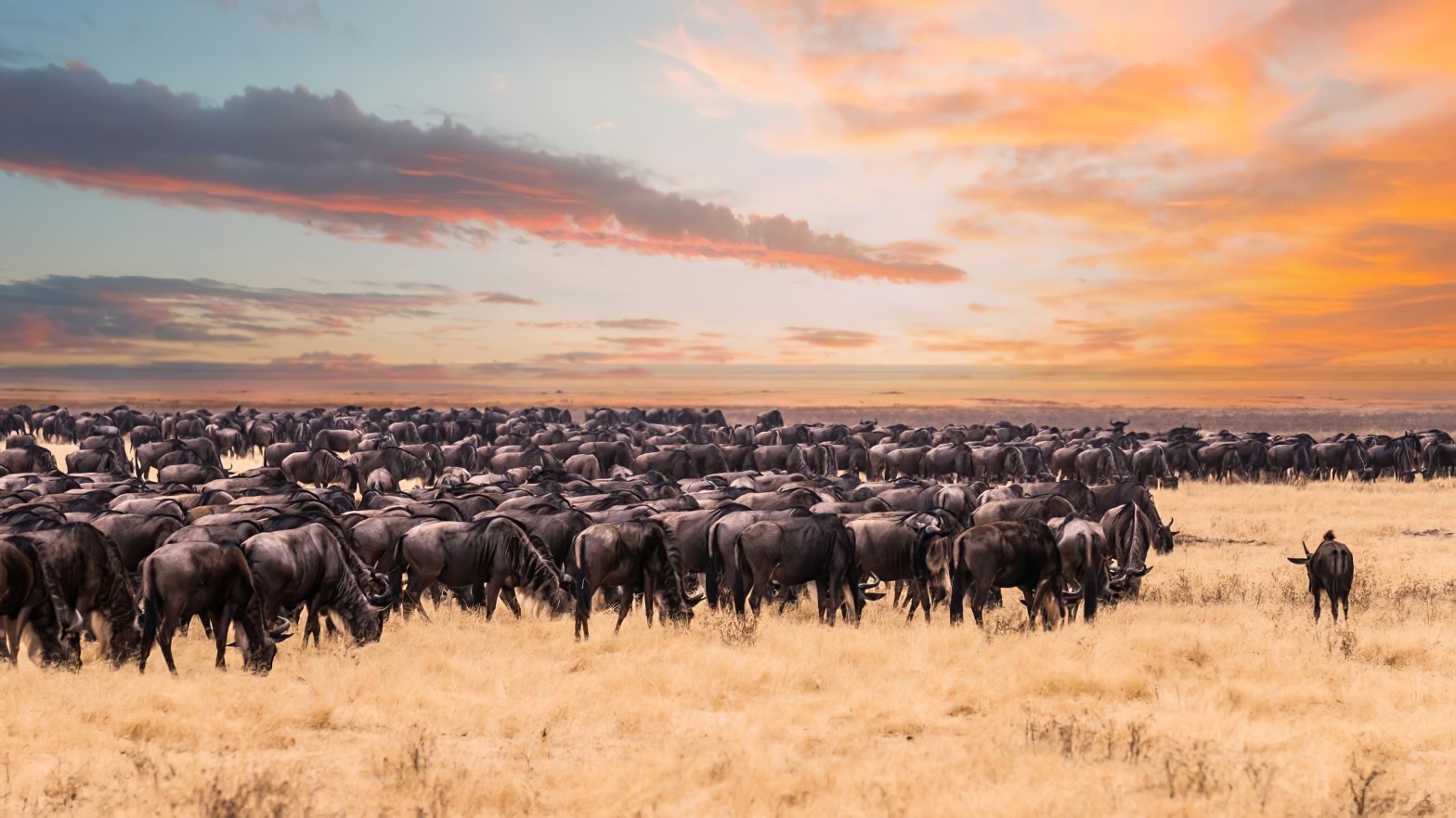
Savannahs of the Serengeti (Photo from https://www.thetimes.co.uk/article/walking-with-wildebeest-in-the-serengeti-7mdnx27dh)

We all have this beautiful picture in our mind of Wildebeests, Zebras, Elephants and Cheetahs running around in an enormous grassland and a sunset in the backdrop. Everybody knows what this grassland is called and where it is found- the Savannahs of Africa. How beautiful! We all want to visit these beautiful Savannahs at least once in our lifetime! 

But what if I told you that Savannahs are majorly found in India as well? Sounds crazy, right? However, it’s actually true. India also has huge tracts of Savannahs.

What is a Savannah anyway?

Savannahs are an ecosystem that have a mixture of trees and grasses, and are characterised typically by an open tree canopy and a grassy layer on the ground. The tree density might be a continuum ranging from:

  1. Near zero trees at all in a Savannah, just an open grassy region. (Grasslands)- example: Serengeti in Africa ; region around Saswad in Pune, India.
Grasslands from the region around Saswad, Pune. (Photo from https://sustain.round.glass/habitat/wilds-saswad-vibrant-grassland-near-pune/)

2. A few scattered trees with the grassy layer on the ground. (Scrublands) – example: the hills in Pune city, India.

A Scrubland habitat with a few scattered trees on one of the Pune Hills

3. A fairly high density of trees, but not dense enough to shade out the grassy layer on the ground. (Wooded Savannahs) – example: Pench, Nagzira, Tadoba, Bandipur etc. in India.

Nagzira Tiger Reserve in Central India, a perfect example of a Wooded Savannah. (Photo by Paresh Deshmukh)

All these are the different kinds of Savannahs found throughout the world and in India. The grassy understory is the distinguishing feature of any kind of Savannah.

Different types of Savannahs based on the density of trees, the continuous grassy understory is present everywhere

Now let us understand what a forest is. A forest is a closed canopy ecosystem with a dense tree cover. There is no grassy understory in a forest, unlike a Savannah (for example- Bhimashankar, Lonavala, Mahabaleshwar, Amboli in Maharashtra, India.)

Forest at Amboli, Maharashtra. Note that a continuous grassy understory is absent. (Photo from https://www.researchgate.net/figure/Type-locality-of-Calliophis-castoe-Amboli-Sindhudurg-district-Maharashtra-India_fig9_260086304)

Savannahs in India are not something rare to find. There might be a Savannah right next to your house. In fact, almost the entire peninsular region of India to the east of the Western Ghats is a Savannah. Be it the dry, thorny scrub plains of the Deccan Plateau in Maharashtra, the dry lands of Rajasthan and Gujarat, the so called “Deciduous Forests” of Central India or even a few regions up North and several regions down South, are all Savannahs. 

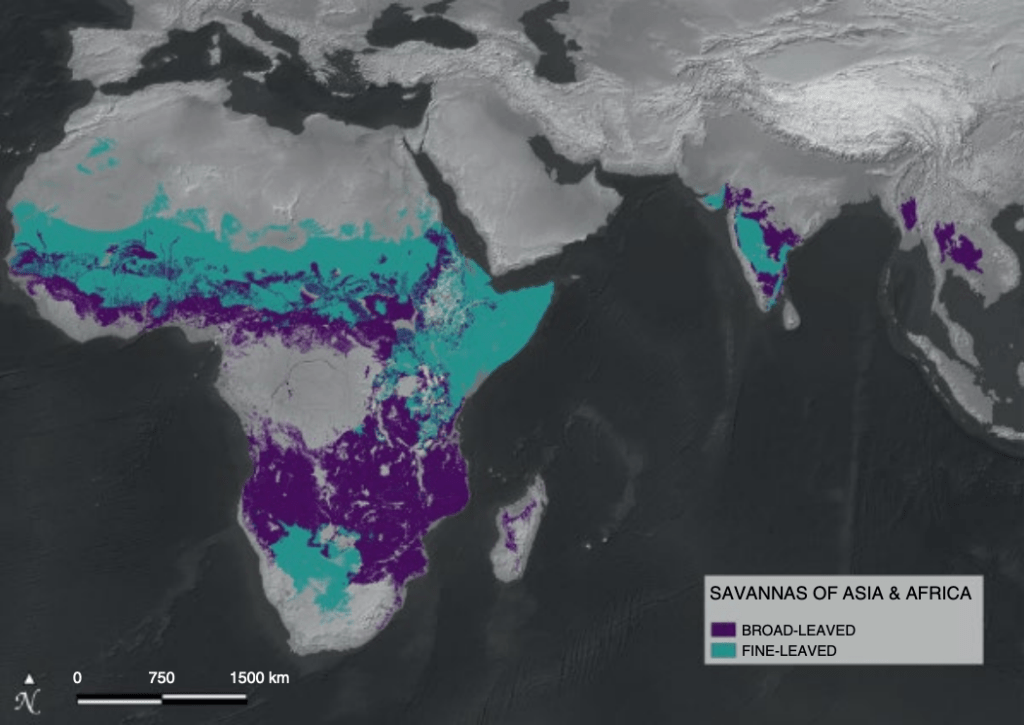
Distribution of the African and Asian Savannahs (source)

Why aren’t we aware of the Savannahs of India if they cover such a large portion of the land in our country? 

The reasons are deep rooted in our history. During the British colonial era, the foresters trained in forestry traditions of the West looked at these habitats from a commercial perspective. Timber and other such extracts were important to them. Since they only focused on trees, Savannahs with some trees in it were labelled as “Deciduous Forests” (There go your Central Indian Savannahs). Due to this forestry-centric bias of the Britishers, the open grassy biomes were labelled as degraded forests or wastelands that require help. Since these lands didn’t earn them any revenue, they were either converted into forests by planting commercially valued trees or were given away for other purposes to generate revenue. The Britishers left us with this system and this nomenclature. Open Grassy Biomes with minimal or no tree cover were etched as “Wastelands” in the minds of the governments and the rest were termed as “Deciduous Forests”, “Thorny-Scrub Forests” etc. The word Savannah was lost. Labelling what is not a “forest” as a “forest” causes issues, as both are different habitats. These misconceptions and wrong terminologies created a lot of problems that we are facing even today. (Some of which you’ll be reading in my next blog)

During the post-independence era, a lot of transformations occurred with the Green Revolution. These so-called Wastelands were converted into “forests” by carrying out tree plantations of exotic species or were made into farmlands. A great example of this would be the Gliricidia monoculture on the hills of Pune city. The forest department did a mass plantation of Gliricidia sepium– a tree native to Mexico, on all the hills of Pune city that were originally Savannahs, in the 1950s. Today, we only have a small portion of these hills that still have their original Savannah habitat, the rest is covered by Gliricidia that has drastically changed the ecosystem. 

Exotic Gliricidia sepium monoculture by the forest department on the hills of Pune city

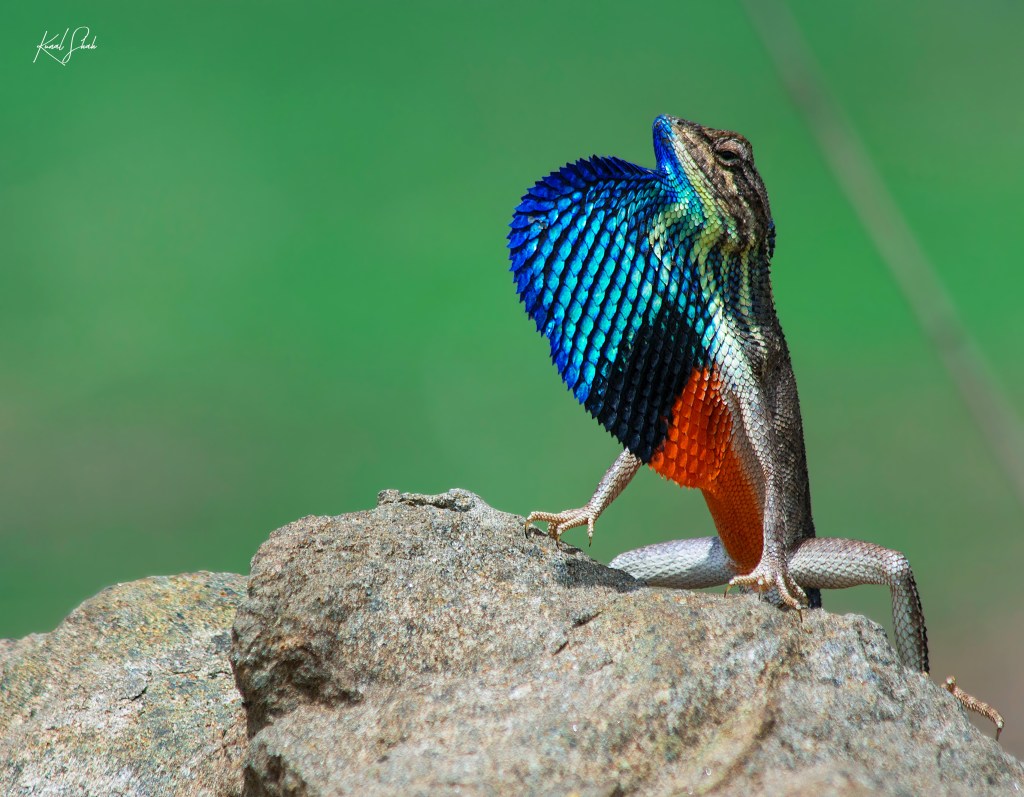
Following the colonial mindset, most of us think that Indian Savannahs are of a recent origin, and were created due to human activities. If this were indeed true, that is, if there were forests here before the savannahs, one would expect to see signs of high tree density causing canopy closure, without a grassy understory in the past. However, historical records- photographs, notes, paintings that take us back a few hundred years show that these habitats were as they are right now, a few centuries ago. Paleoecological research, survey of pollen fossils suggests that these lands were dominated by grassy species and typical savannah species even a few million years ago. In fact, there are typical Savannah plant species that we find in these lands today that have evolved over millions of years to thrive only in this ecosystem. There are so many species of fauna that have evolved over millions of years to be only found in the Indian Savannahs, they are endemic to this region. Take for example the Fan Throated Lizard- a typical Savannah group of lizards that are only found in the Indian Savannahs. Molecular phylogeny suggests that these lizards have evolved over millions of years with the Savannah ecosystem. Their activities are so dependent on this ecosystem that they wouldn’t survive if suddenly this ecosystem were to disappear tomorrow. 

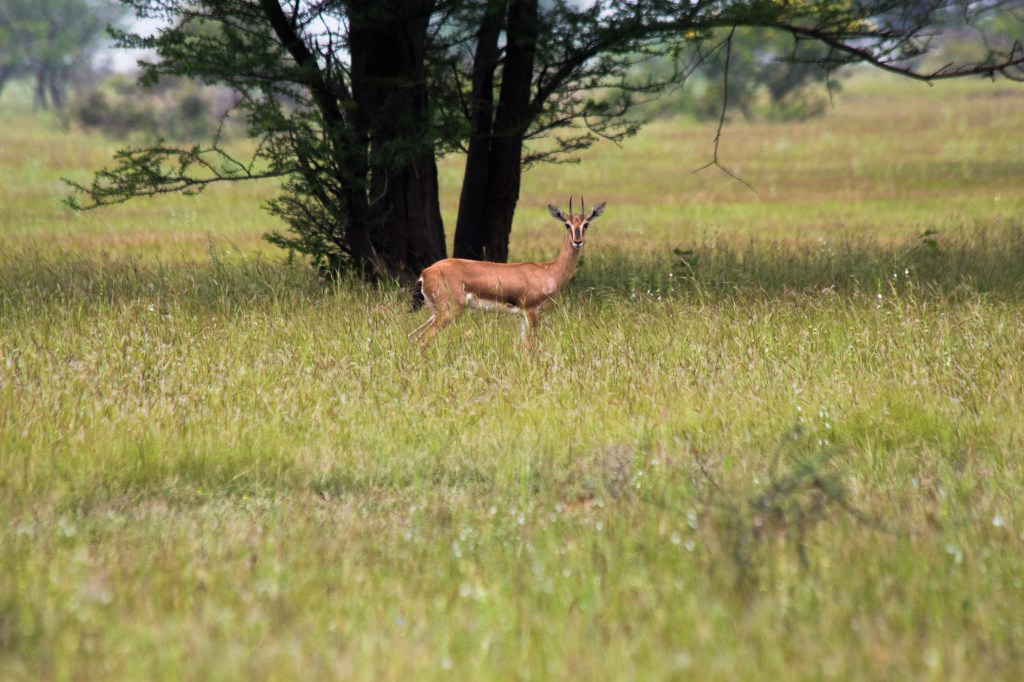
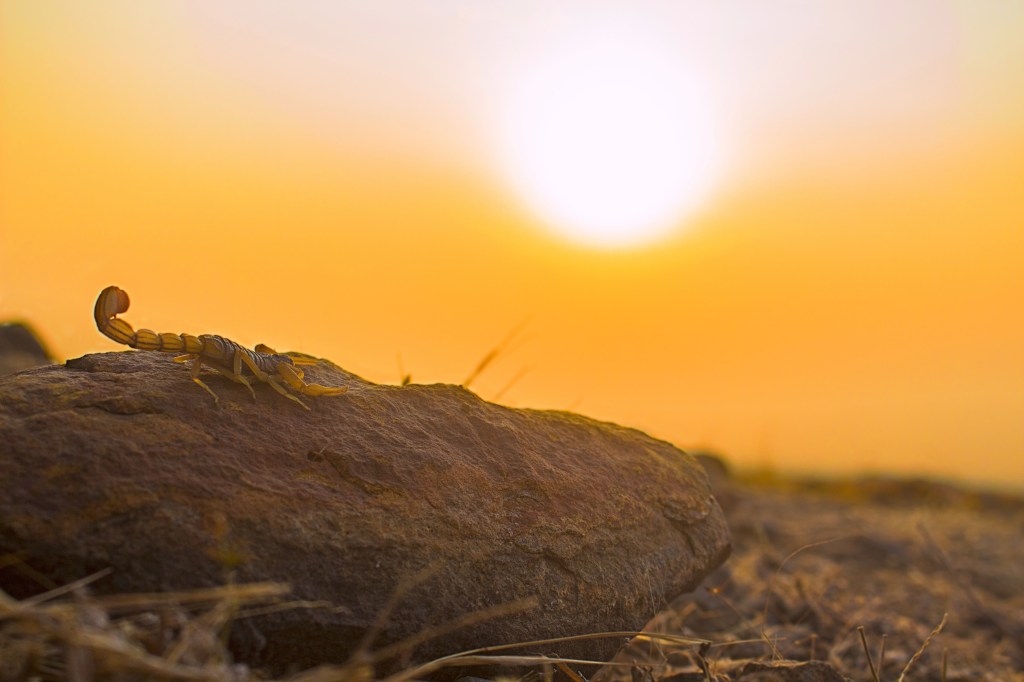
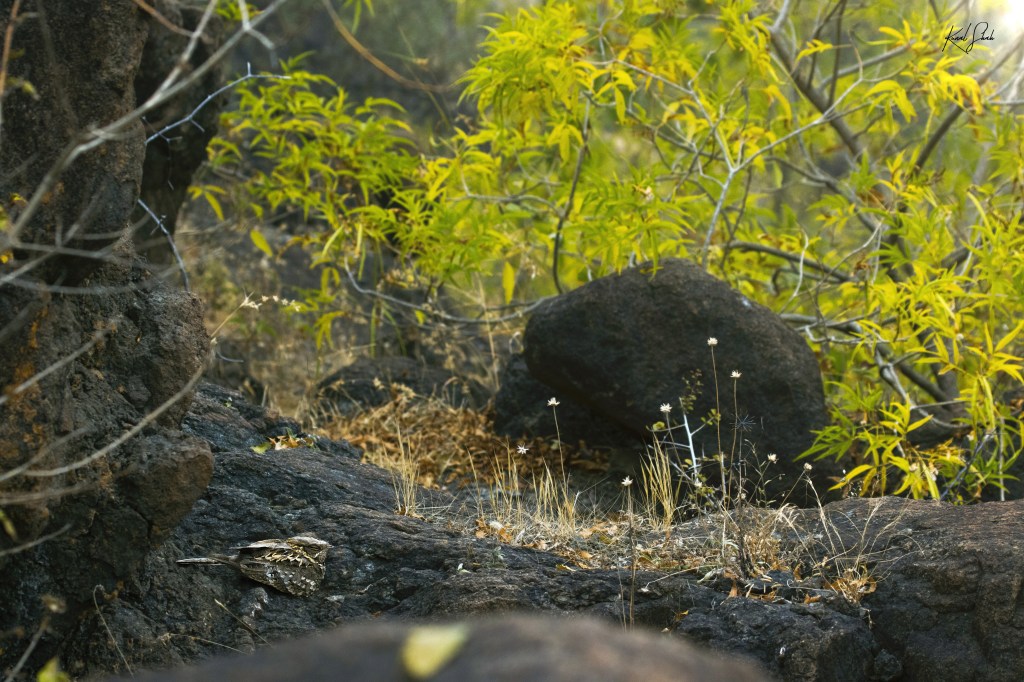
Typical wildlife of the Indian Savannahs- (1) Deccan Fan Throated Lizard (2) Indian Gazelle (3) Indian Red Scorpion (4) Indian Nightjar

Now considering our earlier hypothesis that these Savannahs were actually forests before they got degraded, we wouldn’t find so many endemic species of flora and fauna that have evolved over millennia to thrive only in this ecosystem. This proves that the Savannahs of India are indeed quite ancient and not recently formed due to anthropogenic activities. 

Sadly, we still believe in this narrative that the Britishers put forth of Indian Savannahs being degraded forests and our policies are designed according to this belief. Till this date, most of the Savannahs in India except a few that have been wrongly categorised as some kind of a ‘forest’, don’t have a legal protection status. Our education teaches us that these long stretches of land with negligible tree cover are “barren” and are wastelands, that we need to plant trees in them to give them life, which is, although well intended, but not supported by science. Savannahs are still converted to farm lands, dump yards or are given away for urbanisation. The government has also proposed afforestation projects to make these habitats green “AGAIN”. These Savannahs have been as they are right now since the past 4 million years. There’s no question at all of making them “green AGAIN”.

Pits and trenches dug by the Forest Department on the hills of Pune city which are essentially Savannahs, for tree plantation. (Photos by Ashish Nerlekar)

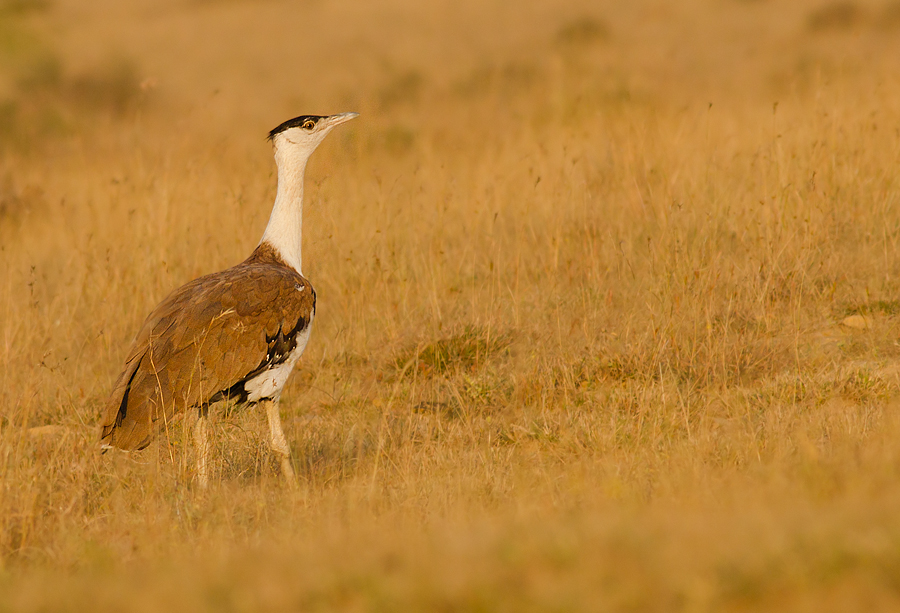
Scrublands and Grasslands might appear to be dry and lifeless to us, however they are actually full of life. They are home to a variety of plant, mammal, bird, arthropod, reptile and amphibian species that cannot thrive anywhere else. Clearing these habitats or converting them into something else under the name of development, planting trees here will only lead to its destruction and the extinction of the many MANY species that depend on it for their life. A classic example of this is the Great Indian Bustard. We all know that this species is on the verge of extinction with only a few hundred birds alive. The major reason for this is habitat loss, destruction of the Indian Savannahs. It’s high time that we realise and appreciate the importance of our Indian Savannahs and conserve them.

The critically endangered Great Indian Bustard (Photo from https://en.wikipedia.org/wiki/Great_Indian_bustard)

What can we as individuals do to protect the Indian Savannahs? 

The very first thing that we can do is call them Savannahs, or the vernacular equivalent- for example, ‘Malraan’ in Marathi. They are not barren lands, they are not wastelands, they are also not deciduous “forests”. We must understand the importance of these Savannahs. Like Forests with tall, green trees, these dry Savannahs are equally important habitats that are home to a unique flora and fauna. We must understand that activities such as tree plantations in these habitats, however well intentioned they are, are not ecological. Once we start acknowledging and appreciating the identity of our Savannahs, only then can we make policies that favour not only the Forests but also these ancient Savannahs that cover a major land of our country. 

————————————————

Also, did you know- these Savannahs have been maintained ecologically by regular fires since millions of years. Yes, the ones that we call “Forest fires”. But aren’t forest fires bad and cause destruction to the environment and the ecosystem? Turns out, we’ve been looking at them all wrong. Not all Forest fires are bad. In fact, we need some of these fires! Read about it in my next blog (which would be the second blog from this series about Savannahs)- ‘Are Forest fires really bad?‘ . Here’s the link- https://kswild.video.blog/2021/01/17/are-forest-fires-really-bad/

If you have any queries or want to have a discussion, you can comment below or ping me on Instagram (@ks_wild). I would be happy to have a chat. 

Special thanks to my friend Ashish Nerlekar for his help with this blog.

———————————————–

Here are a few references that would give you a further insight on how the Indian Savannahs are ancient, their importance and how their destruction in any form- urbanisation, conversion, tree plantation etc. can have irreparable consequences:

1) Ratnam, J., Tomlinson, K. W., Rasquinha, D. N., & Sankaran, M. (2016). Savannahs of Asia: antiquity, biogeography, and an uncertain future. Philosophical Transactions of the Royal Society B: Biological Sciences, 371(1703), 20150305. Available at: https://royalsocietypublishing.org/doi/10.1098/rstb.2015.0305

2) Ratnam, J., Sheth, C., & Sankaran, M. (2019). African and Asian Savannas: Comparisons of Vegetation Composition and Drivers of Vegetation Structure and Function. Savanna Woody Plants and Large Herbivores, 25-49. Available at: https://www.researchgate.net/profile/Jayashree_Ratnam/publication/335603812_African_and_Asian_Savannas_Comparisons_of_Vegetation_Composition_and_Drivers_of_Vegetation_Structure_and_Function/links/5dade0c0299bf111d4bf8780/African-and-Asian-Savannas-Comparisons-of-Vegetation-Composition-and-Drivers-of-Vegetation-Structure-and-Function.pdf

3) Kumar, D., Pfeiffer, M., Gaillard, C., Langan, L., Martens, C., & Scheiter, S. (2020). Misinterpretation of Asian savannas as degraded forest can mislead management and conservation policy under climate change. Biological Conservation, 241, 108293. Available at: https://www.sciencedirect.com/science/article/pii/S000632071931256X?casa_token=EsBaurTZdFoAAAAA:SE7nqaXCO_–wDt6txBHKx8vZMBREJ4KkBocB3hNnU979oXQgINKU4iSioHjXCkb5-UjeiXZKOA

4) https://researchmatters.in/news/identity-crisis-indian-savannas

5) https://thewire.in/environment/open-savannahs-versus-wooded-thickets-whats-the-future-for-punes-hills

6) https://www.youtube.com/watch?v=tnitRnnLBPU&t=257s

7) https://www.atree.org/wfd_savannas

Not an Ordinary Kitten

Pune city is one of the most developed and urban cities of India. In spite of being such a crowded and a modern city, it hasn’t lost its touch with nature. It is one of the few urban places that is blessed with amazing natural biodiversity hotspots within the city. Pune city has a chain of connecting hills within the city that are full of natural life. These hills are rightly called the lungs of the city as they help to balance the urban development taking place in the city. Now, unlike typical hills, these hills aren’t tall or pointy. They have a moderate elevation and are actually plateaus with long stretches of flat lands on the top. These flat lands are primarily grasslands which have now partly been converted into deciduous forests. Almost all the hills in Pune city are connected, and you can go from one hill to another. 

One such popular hill in Pune, the one that I visit frequently for my wildlife outings and the one that I think is the most popular of all is called Vetal Tekdi. I have referred to this hill as “The Hill” in my previous blogs (and I shall continue to do so). Vetal Tekdi is a very popular hill among the people of Pune city. Thousands of people visit this hill every single day to get away from the city life, to exercise, to chill, or to explore its wildlife, like I do. 

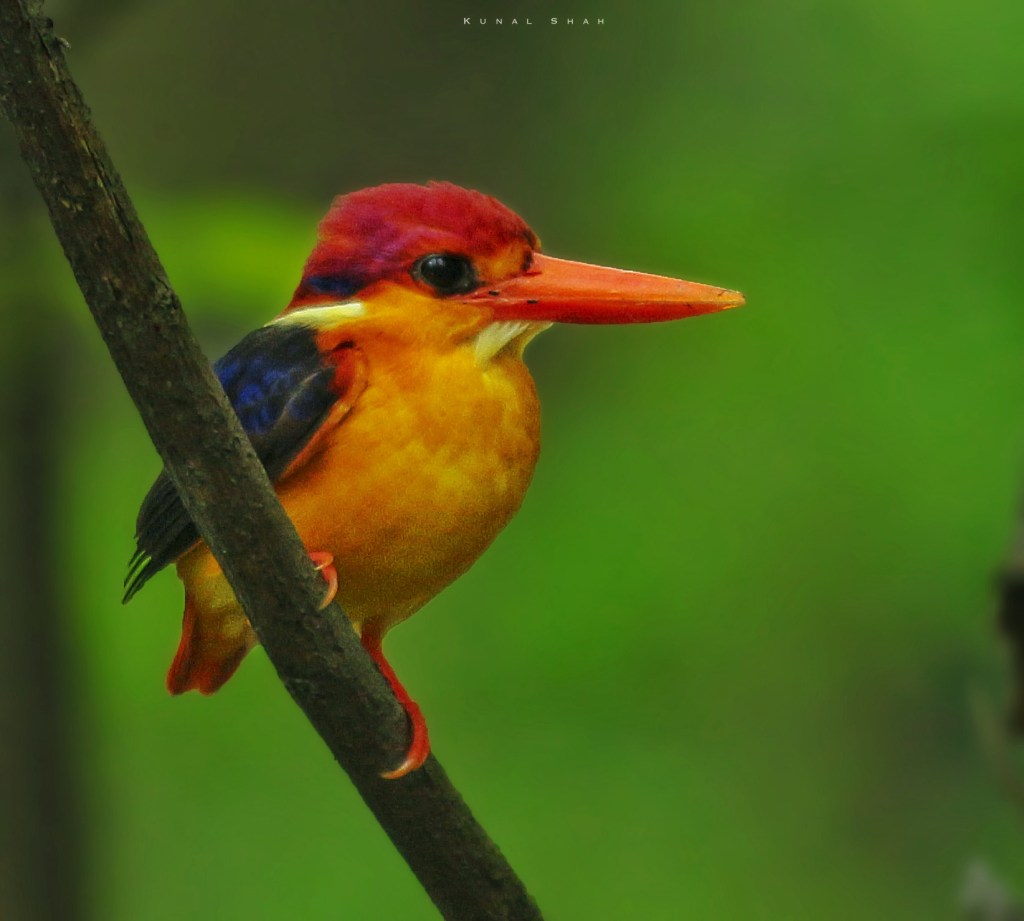
Speaking about the wildlife of the Pune hills, there is an abundance of bird life here. Even though it’s literally at the heart of the city, in spite of so many people visiting it on a daily basis, the bird life here has remained intact over the years. I myself have sighted quite a few rare birds at Vetal Tekdi over the past 10 years. The rarest of them all is the Oriental Dwarf Kingfisher, which is an impossible sighting for any of the Pune hills – because the habitat that this bird requires no where matches with that of the hills or anywhere near the city. It was a lost bird and it flew away within 5 days. It is probably the only record (that too photographic) of this bird from here.

The lost Oriental Dwarf Kingfisher at Vetal Tekdi, June 2015

There aren’t a lot of mammals on these hills. Indian Palm Squirrel is the most common mammal here, but it is almost throughout the entire country as well, so no biggy. One might see an Indian Mongoose if they’re lucky, a Black naped Hare if they are luckier. But that’s pretty much the mammal life here at Pune hills. 

I sighted a Barking Deer once at Vetal Tekdi, which is a very rare record and might be the only known photographic record from there in the past decade at least. Now, the mystery here is that the animal that I think was a Barking Deer was actually quite far and the photo that I have got only confirms that it’s there. There’s another mammal called The Four Horned Antelope, which looks exactly like the Barking Deer from a distance and is even rarer, making it a bigger jackpot. But we would never know if the one that I saw was a Barking Deer or a Four Horned Antelope based on my photo.

A few of my friends have such isolated records of Barking Deer from some other connecting hill, but it is not at all easy to spot one.

The Barking Deer (or possibly a Four Horned Antelope) from Vetal Tekdi, June 2015

However, recently, I along with one of my friends sighted an extremely rare mammal here at Vetal Tekdi – The Jungle Cat. The Jungle Cat is one of the 15 species of Wild Cats found in India. It might not be that rare to spot away from the city, in forests or rural areas, but sighting one at Vetal Tekdi is a BIG deal. It is a very shy and elusive wild cat that no one even imagined had its presence on the Vetal Tekdi hill chain. 

We always thought that there might be a slight possibility of Jungle Cats existing here on Pune hills, but hardly anyone had ever seen it or even found traces of its existence. This probably is one of the only known and documented records of The Jungle Cat from Vetal Tekdi in modern times (according to a study published in 1987, it almost disappeared post the 1960-70s from the hill complex and surrounding region where it was once found, due to habitat loss). 

The story of this blog hasn’t started yet. This was just a small introduction of Vetal Tekdi and its connecting hills, to provide you with an outline, a context for the story. I’ll be writing an entire blog about Pune hills sometime soon, but right now, let’s get started with the story. 

Before starting, let me just tell you that everything that I’ve said till now and everything that I’ll be saying from now on is based on the sightings at the accessible part of the Vetal Tekdi hill chain. There are a few areas that are restricted for people as they belong to the military, no one knows what goes on in there and about the wildlife that is present there. I suspect that it’s rich in biodiversity, but we’ll never know.

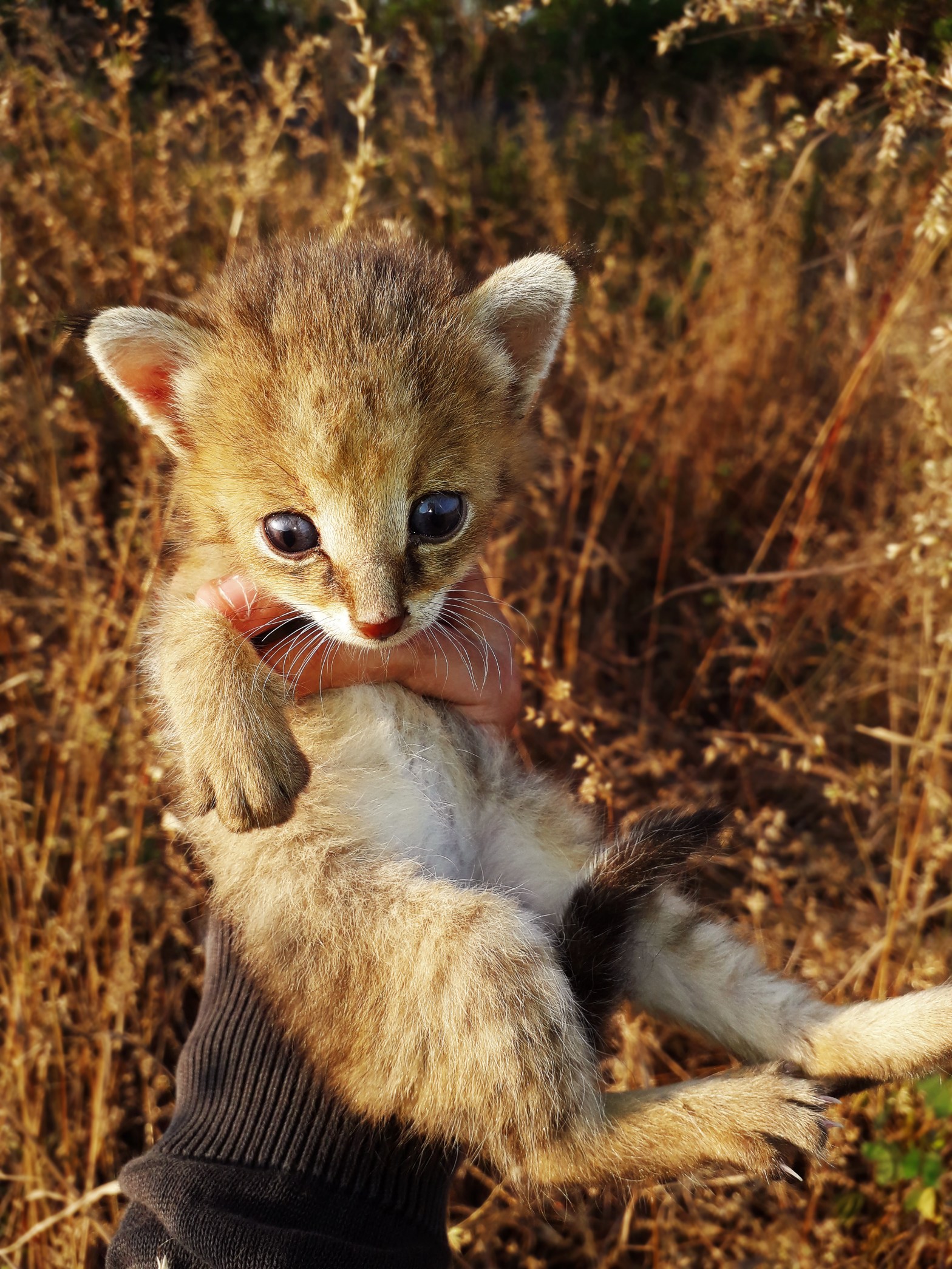
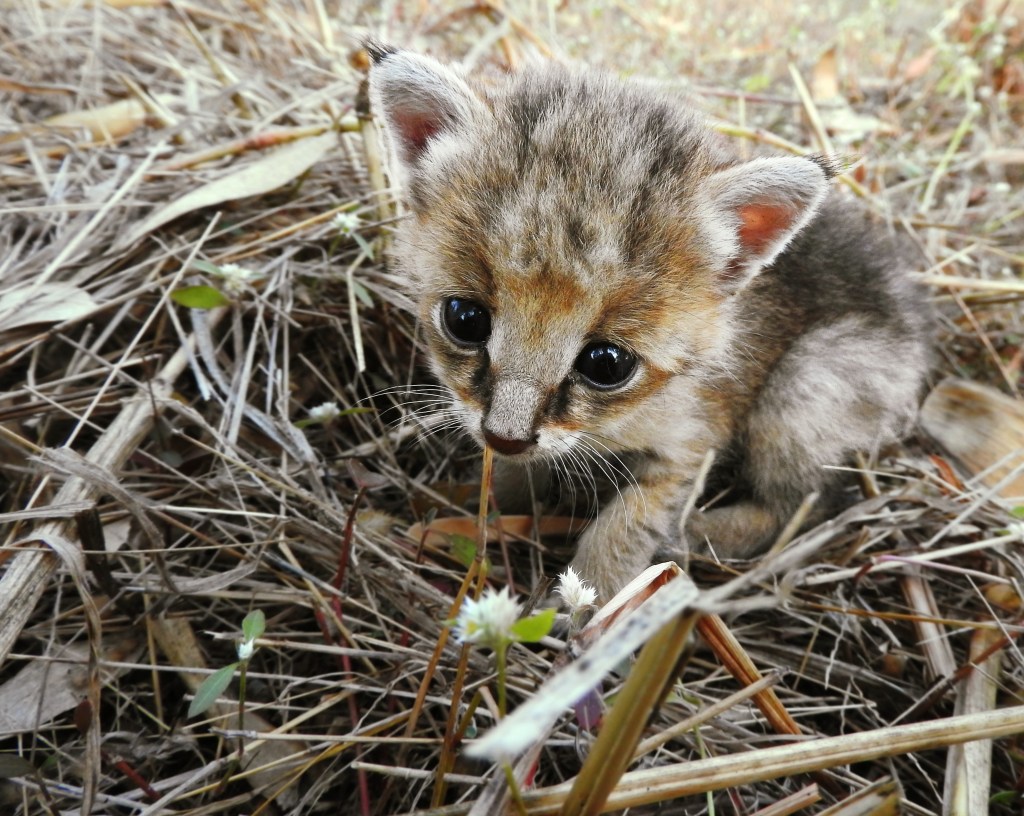
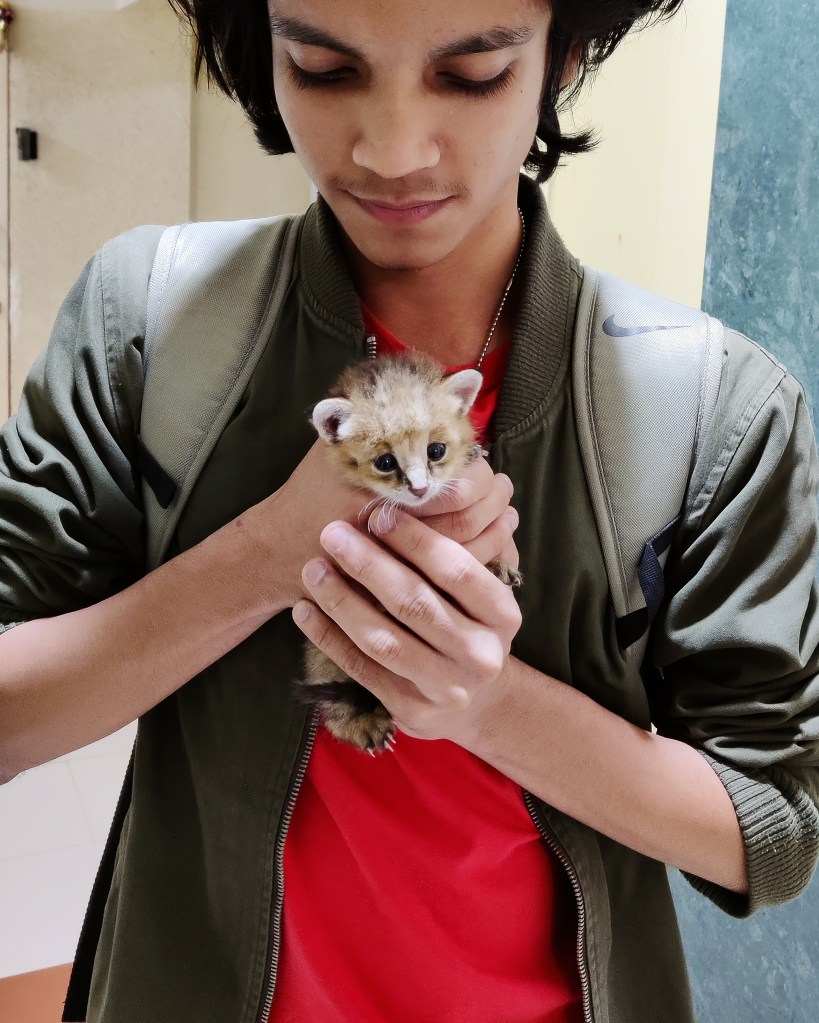
So it all happened a few days ago when one of my friends, Kunal (yes his name is Kunal as well), was out for a small birding session on Vetal Tekdi one fine afternoon. He came across his usuals, a Kestrel, a daily White Eyed Buzzard, Indian Rollers, and some other birds that are seen regularly. Suddenly, while walking on his daily route, he heard a few loud, distressed young Meows from the tall, dense grass next to him. Having raised a few kittens earlier, he suspected that a poor hungry Kitten must be lost in the grass. He realised that a few crows were sitting on a nearby tree who could easily attack the poor kitten. Slowly, he made his way into the tall dry grass in order to help her. Kunal(not me lol, my friend) made a few “psspss” sounds to attract the kitten and she responded to them very well by revealing herself out of the dry grass. As soon as the kitten came close to him, he dropped dead silent.  It was no ordinary kitten that was crying for help. It was a kitten of the rare Jungle Cat! He immediately called me and his brother, Tanay to tell what had happened. 

I was speechless when I got the news. My heart skipped a beat and then started racing fast, my mind went blank. Kitten of a Jungle Cat that too at Vetal Tedki!? How crazy is this!? Is this even real!? This was way beyond my imagination, way beyond my wildest dreams. But wait, are you sure it’s a Jungle Cat and not an ordinary Kitten, I asked. As far as he knew, he was firm on it being something remarkable. He asked me to come and see it for myself. I immediately rushed to get my backpack and raced to that spot. And OH MY GOD, it was a tiny, cute little kitten of a Jungle Cat, not even a month old. This was happening! But why was it alone? Why was it even here? I was happy that our very own Vetal Tekdi now has a new mammal added to it’s list, however rare it might be. But something was very wrong here. 

The cute little Kitten of the Jungle Cat, not even a month old. Photos by Kunal Gokhale

Why was it meowing at the top of its voice, continuously? It was in such a distress that its voice was cracking with fear. This is not usual. Jungle Cats won’t leave their young kittens at such places that are frequented by humans, that too alone and during the day! The meowing had grabbed a lot of attention of some crows and stray dogs. Dogs have a natural tendency to attack cats and other animals as well. Luckily no other humans were around except us. We were keeping the dogs and the crows away, but didn’t know what to do to help this kitten. As the primary rule of nature goes, do not interfere. 

We waited nearby hoping its mother would somehow come and help her kitten. Four hours passed, yet nothing! It was almost 7.30 pm now, pitch dark. It was difficult for us to stay any further as these hills aren’t a safe place, unfortunately, to wander around at odd times or after dark, due to some incidents of crimes and thefts that have occurred. The crows had left but the stray dogs had found a resting place nearby. There were also some small human settlements around and the Kitten could have definitely gotten some unwanted attention. In either cases, it wasn’t safe to leave the kitten alone. After all, it was the rare Jungle Cat and making sure it survives on Vetal Tekdi was of utmost priority. 

Due to very less time and limited options, we decided to pick up the kitten and take it with us someplace safe. It was a very hard and tough call; however, we did what we felt was right in order to ensure that the kitten survived. On reaching a safe place, we immediately called ResQ Charitable Trust, an organisation that helps stray as well as wild animals.

A team from ResQ came with all their equipment to help the kitten. They collected a few Neem leaves to rub against the kitten as we had touched her with our bare hands while bringing her to safety and it was necessary to get our scent off of her. Then they put her in a safe cage and we all rushed to the spot where we had found her. There they kept the kitten under a basket with a rock on its top and set up a live camera through which we would monitor all that was going on. We left the place and monitored the live camera from a nearby location. If at all the mother arrived, she would flick the rock and get her kitten out of there with her. It was getting pretty late so we handed it over to the ResQ team who were gonna monitor the camera upto 2-3 am hoping for the mother to come. 

Unfortunately, the mother didn’t arrive and the ResQ team had to take the kitten with them to their centre where they fed her. They tried the same process again the next day, in vain. There were no signs of the mother. It is impossible for the kitten to survive on its own in the wild, so team ResQ would now try to raise it in their centre.

This was a one of its kind experience. I still cannot believe that this happened. It is still hard for me to believe that we found a tiny Jungle Cat fur ball which wasn’t even a month old, at Vetal Tekdi! Though this kitten would not roam on Vetal Tekdi with its mother for now, this incident has given me the confidence to say that we have Jungle Cats on our Pune Hills. Hopefully sometime in future, if we’re lucky enough, we’ll get an opportunity to see them. Our search will be on!

——

[I had written this blog around five days ago and had decided to publish it today. However just yesterday, a rare mammal made it in news from the foothills of one of the connecting hills of Vetal Tekdi. An Indian Gaur had wandered off into Pune City at the foothills of Mahatma Hill, making it one of the rarest (and impossible) mammal sightings at Pune Hills (near Pune Hills actually as the Gaur was lost IN the city, next to Mahatma Hill). I got a glimpse of it. Many authorities together carried out a three hour long rescue operation to get the Gaur to safety. I published a blog about it yesterday, totally unplanned. You can read it here- https://kswild.video.blog/2020/12/09/the-rescue-mission/ ]

The Rescue Mission

I woke up with a call today from my friend saying, there’s an Indian Gaur (aka Indian Bison) in the open plot next to his house, five minutes from my place- in a housing society (Mahatma Society) at the foothills of Mahatma Hill (one of the connecting hills of Vetal Tekdi). Well, who would believe it? An Indian Gaur, a huge wild Bovine that weighs 800 kgs, that is found no where near Pune City magically appearing next to your friend’s house in the heart of the city? Is this even possible?

Turns out, it is. He sent me a photo which cleared all my doubts of it being just a huge Cow that he might have mistaken as a wild Bison. As I rushed to dress up and get my camera, the news of this sighting had spread like wildfire all over Kothrud area of Pune City. 

The Forest Department, Fire Brigade, Pune Municipal Corporation, the Police, ResQ Charitable Trust and a few people from Katraj Wild Animal Rescue and Rehab Centre, all had arrived at the place. The police had placed barricades to block the crowding public from entering the place where the Gaur was, while the rest of the authorities were trying to capture it and get it to safety. However, it wasn’t an easy task at all. 

Nets and ropes were placed to restrict the Gaur from leaving the site while tranquillisers were being prepared to calm the Bull down. I was standing away from the scene hoping to document the rescue operation. However, it was not possible to go to the actual spot as it wasn’t safe for us as well as the animal and letting the Rescue Experts do their job safely was of utmost priority. 

A lot of time passed but there were no changes in the scenario. The Fire Brigade and the Rescue Team were still there at the spot and the crowding of people had increased here, with journalists from around 4 different news channels reporting live. The scene wasn’t visible to us and from what we heard, the bull had been tranquillised once. We thought that the mission was successful and that the Bull would now be brought to safety in their rescue truck. But that wasn’t the end of it.

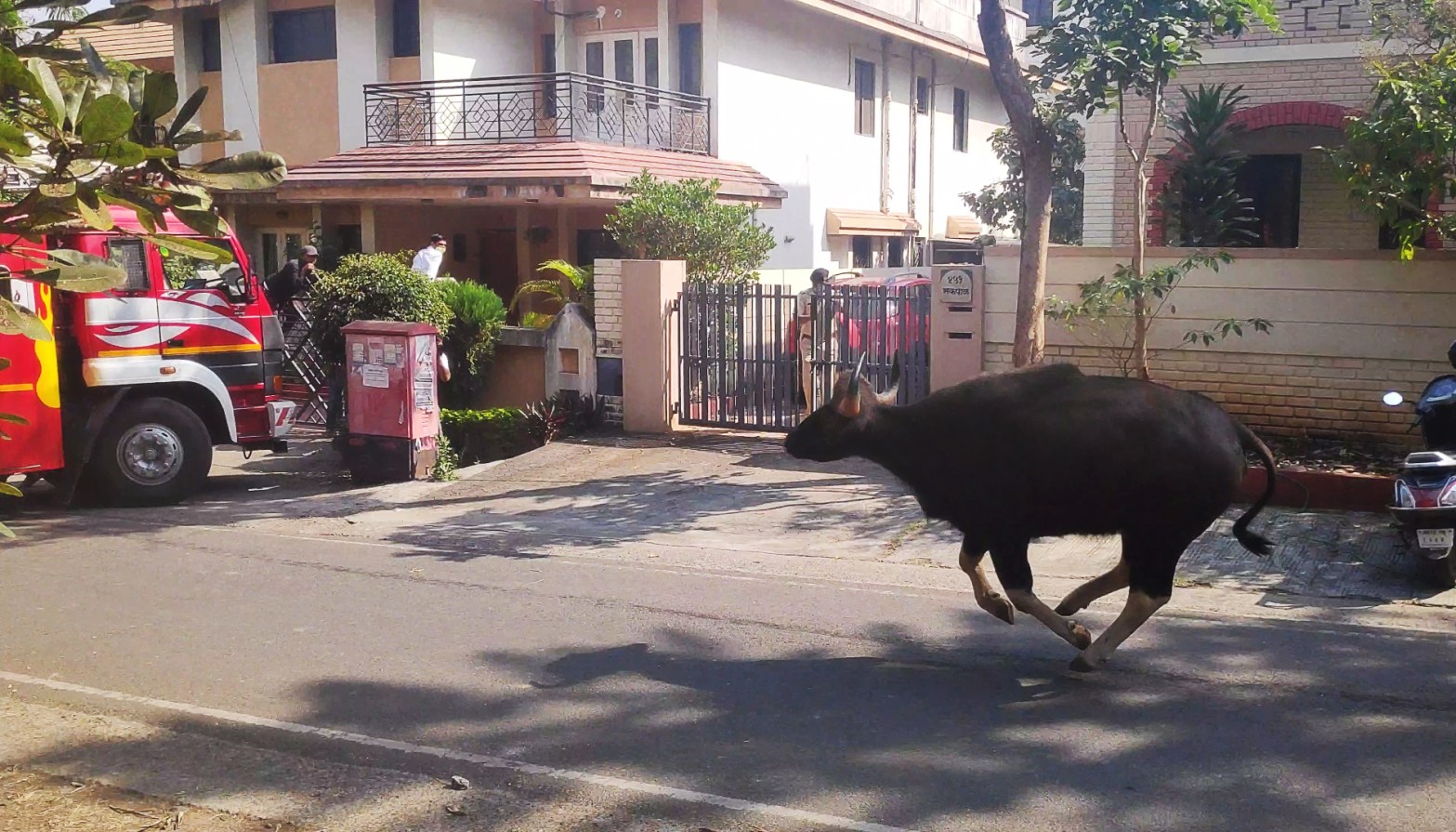
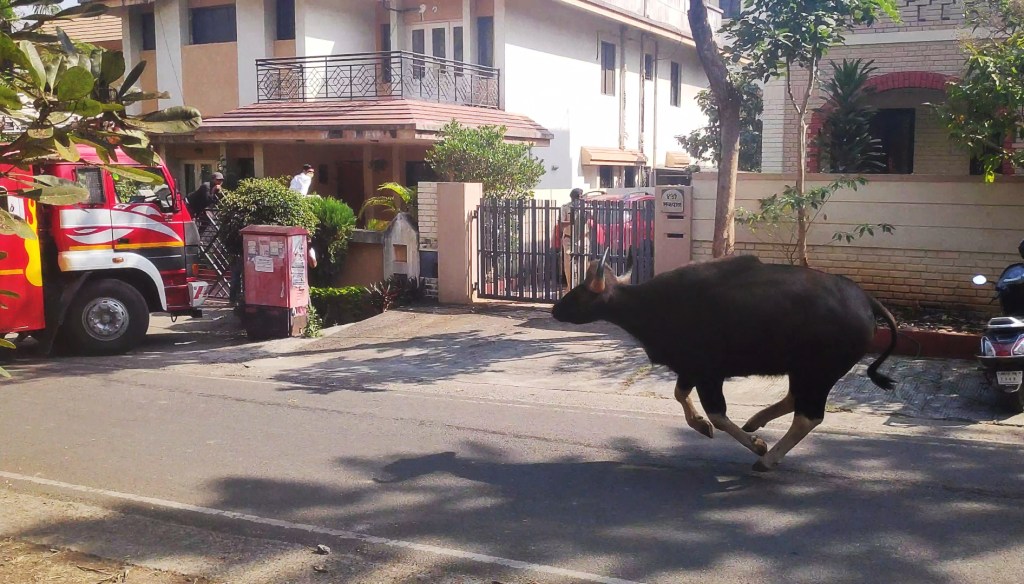
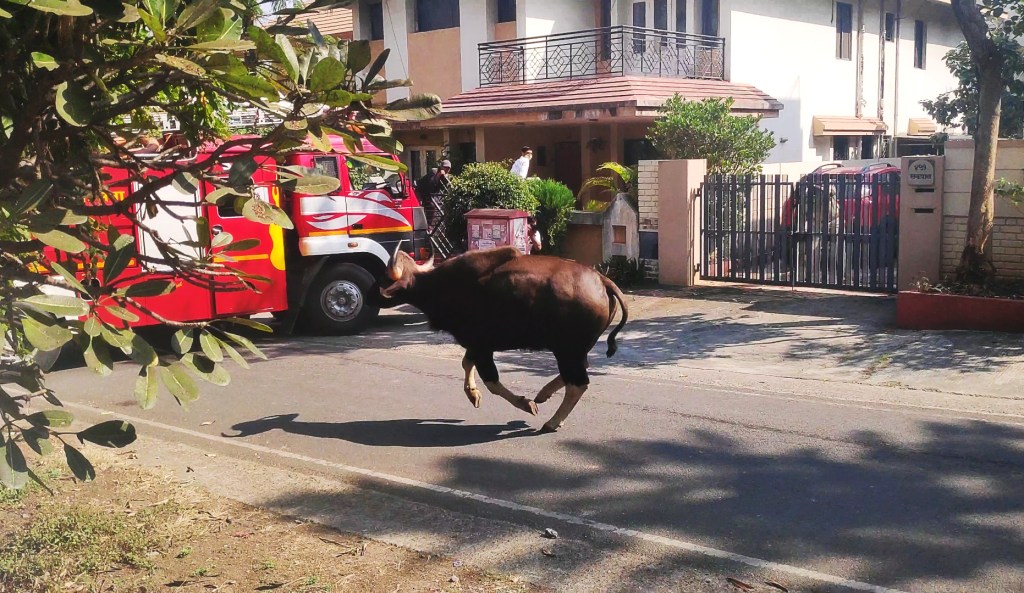
The Bull broke the nets, evaded the big trucks and vehicles and revealed itself on the road. It started running in the direction of the crowd where the barricades were placed. We immediately ran in the lane next to us clearing the street. The Bull was in full speed and took an easy leap over the tall barricades to disappear somewhere in the network of small lanes. We all were stunned to see how easily the massive, heavy bull crossed the barricades. The two Fire Brigade trucks along with several police and rescue vehicles followed him. 

Photos by my friend Aditya Kinjawadekar, who initially called me in the morning

The Bull had been cornered by these vehicles somewhere down the lane, however he managed to evade them again. The Bull was seriously injured on the face and was bleeding, as he had crashed on a gate and some cars apparently, in the early hours. No humans were hurt. The Rescue mission went on for around three hours as the Bull had managed to evade the blockade of the huge fire trucks as well as the rescue vehicles several times. It even jumped tall walls, before making its way through the main road, away from Mahatma Society into some other small lane. I can imagine how shocked the traffic would be on the main road to see this huge Gaur running cross road, being followed by the authorities. Everybody present there was surprised to see such a huge and heavy bull easily dodging all the obstructions in his way.

He was finally captured, tranquillised and put in a Rescue Truck to be carried away at an Animal Rescue Centre for its treatment.

Blood loss of the Gaur due to its injuries. Swipe only if you are comfortable seeing it

Later in the evening, it was confirmed that the Gaur couldn’t make it. Official sources say that he died due to over exertion, high body temperature and stress. A post mortem report would confirm the exact cause of the death. It was unfortunate.

This was an extra-ordinary incident that happened literally at the heart of Pune City. It raises a few concerns of man-animal conflicts as well. The nearest habitat of Indian Gaur around Pune is at Tamhini and Mulshi, both of which are more than 50km away from the city (facts point out that this Gaur wandered off into the city from these forests only).

Spotting an Indian Gaur somewhere deep inside the city is unimaginable and extremely rare. It is believed that there still are some wild corridors that connect these forests to the city. Maintaining these corridors for the free movement of animals and protecting the forests is extremely important to avoid the chances of these animals from entering the city and to avoid man-animal conflicts. 

Baby’s Day Out

This bird was literally having his Baby’s Day out moment. Read about it in the blog 🙂

Summer 2020 is over and the monsoon has arrived. Still no sign of Covid-19 leaving us. I think it’s just the new way of life now, we’ll have to live with it. The lockdown eased up for a while after an entire Summer, in the first week of June. I hadn’t left my house even once for around three months, for the first time in my life. When life was normal, I hardly ever used to be at home. I’m an overly extroverted person and this sitting at home for months, literally pressing the pause button of life was driving me crazy. June came and I finally stepped out of my house for the first time, wearing my mask at all times like I was Spiderman keeping my identity. Of course I couldn’t go and meet anyone. But more than meeting anyone, there was one thing that I was craving for, something that I hadn’t done in months, even before corona arrived, a Wildlife outing. I rushed, alone, to one of my most favourite places, The Hill. (I’ve talked about this place in my previous blogs, especially in the blog called ‘The Invisible Bird’. Check it out later- https://kswild.video.blog/2020/03/11/the-invisible-bird/ )

Finally, after I don’t know how many months, I was back. Back at this place, back to my favourite kind of habitat- Scrublands, back to do what I love to do the most. After a breath of fresh air and admiring the beauty of The Hill, I got back to work, finding Wildlife.

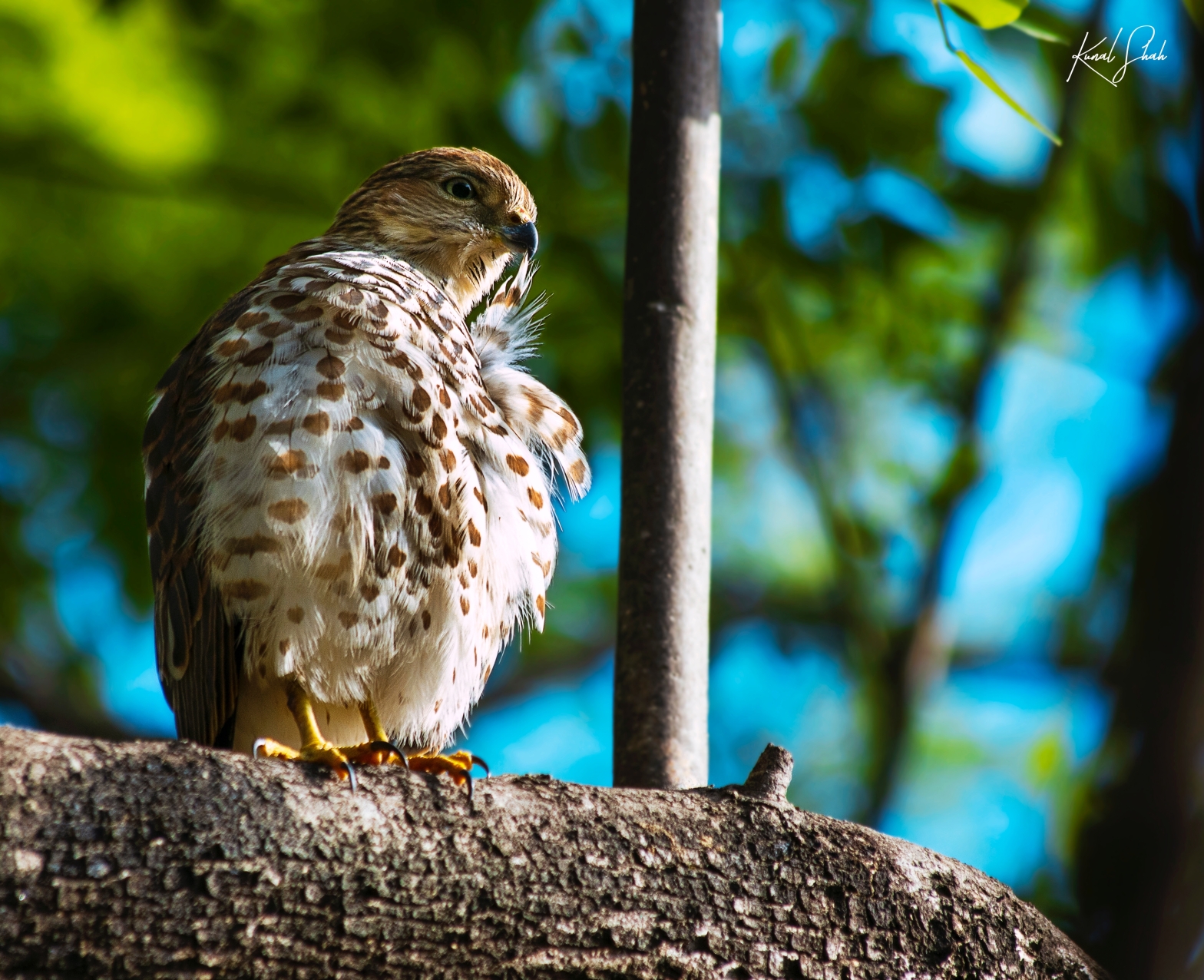
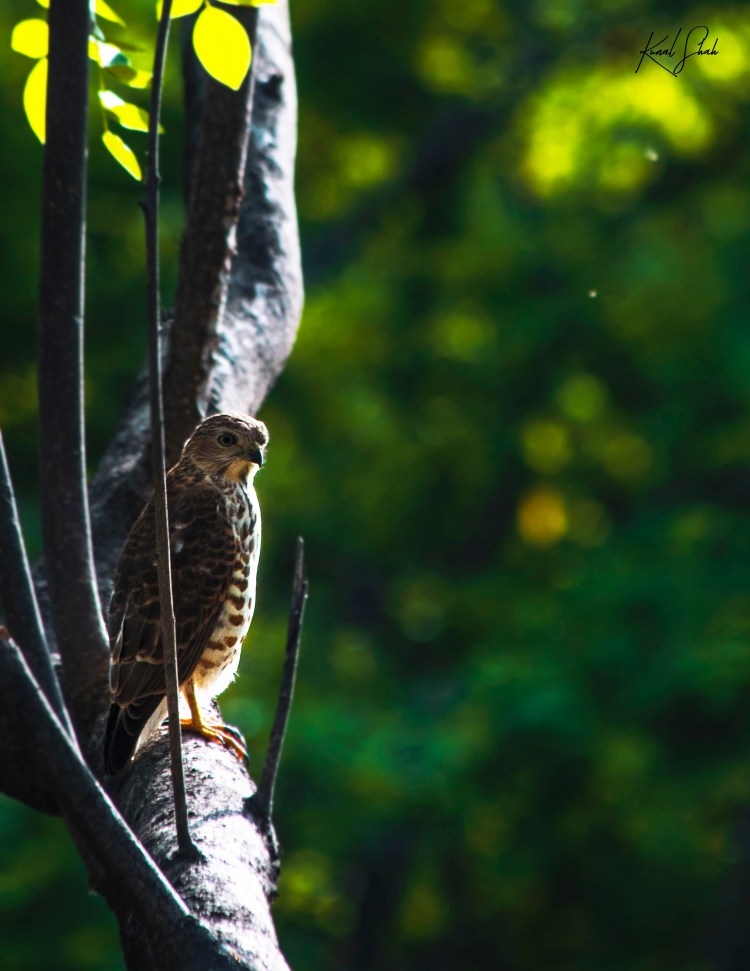
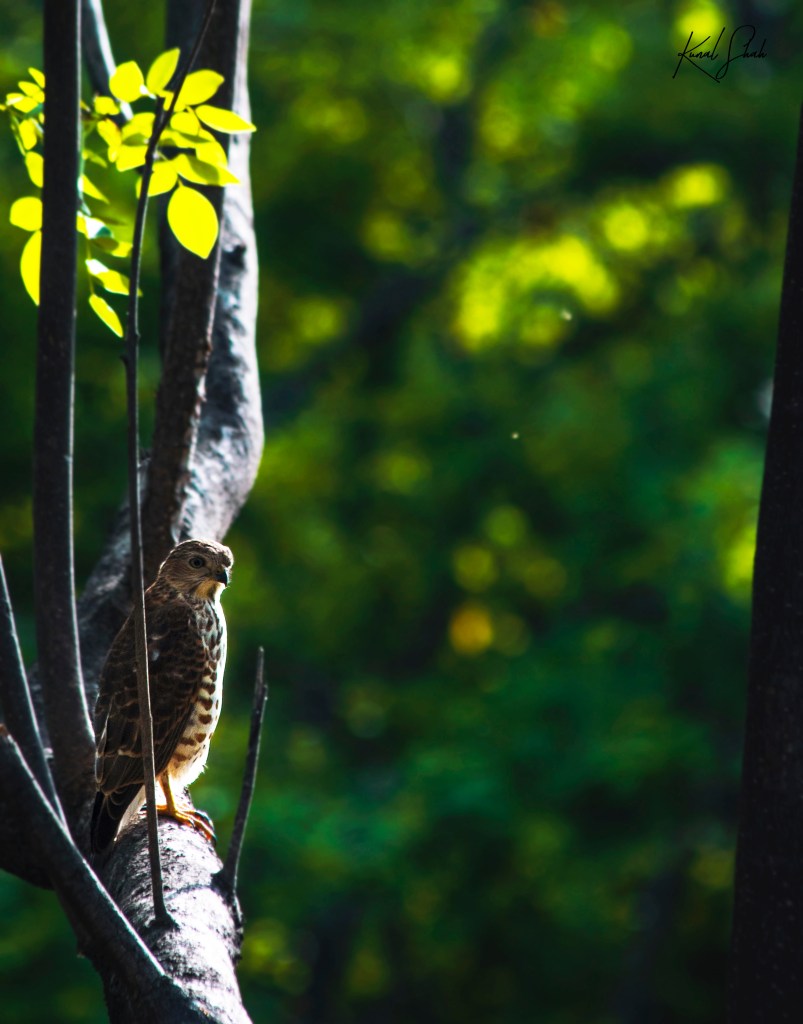
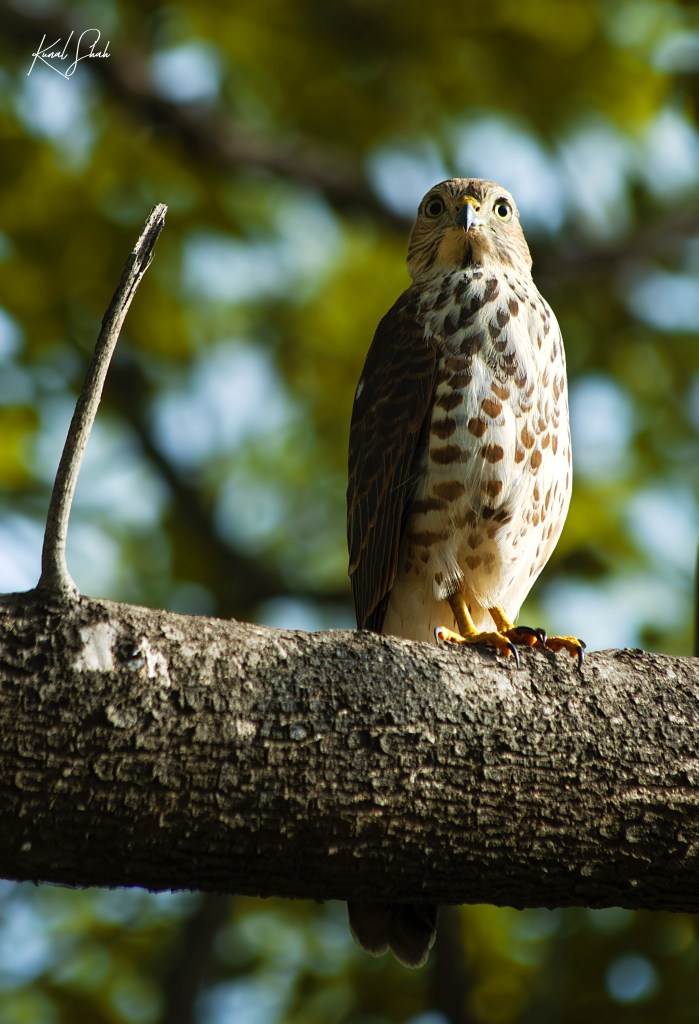
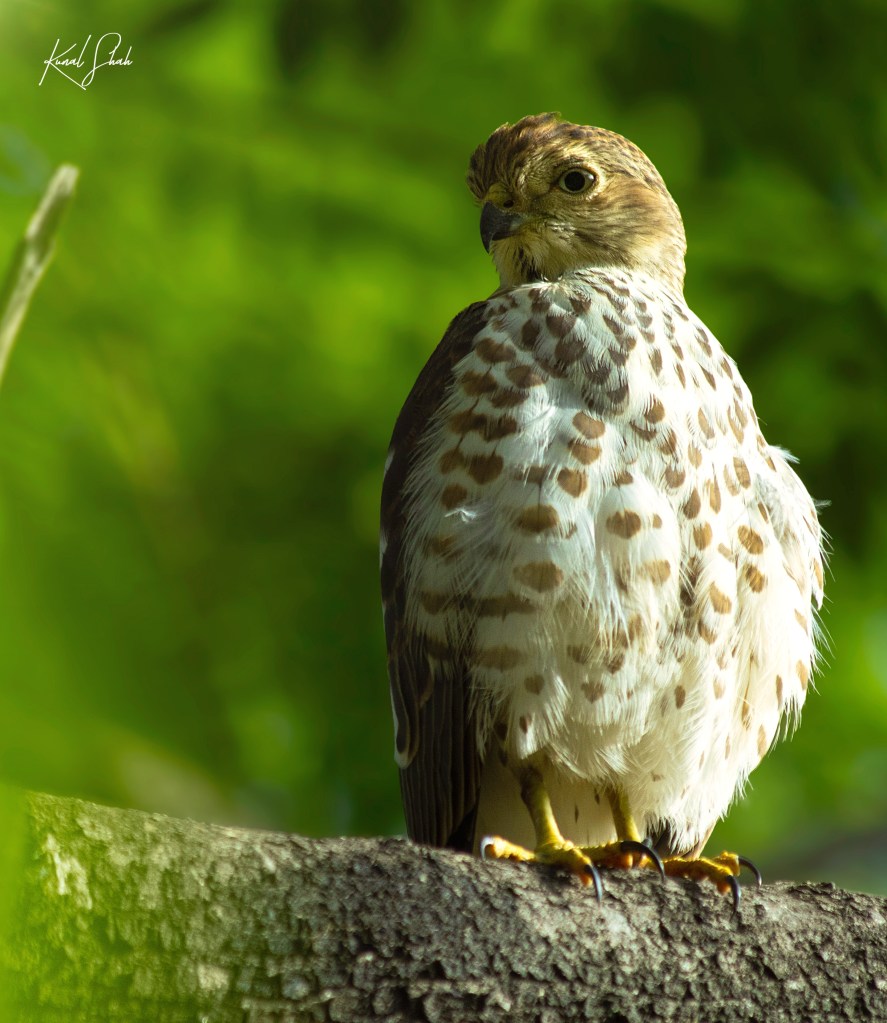
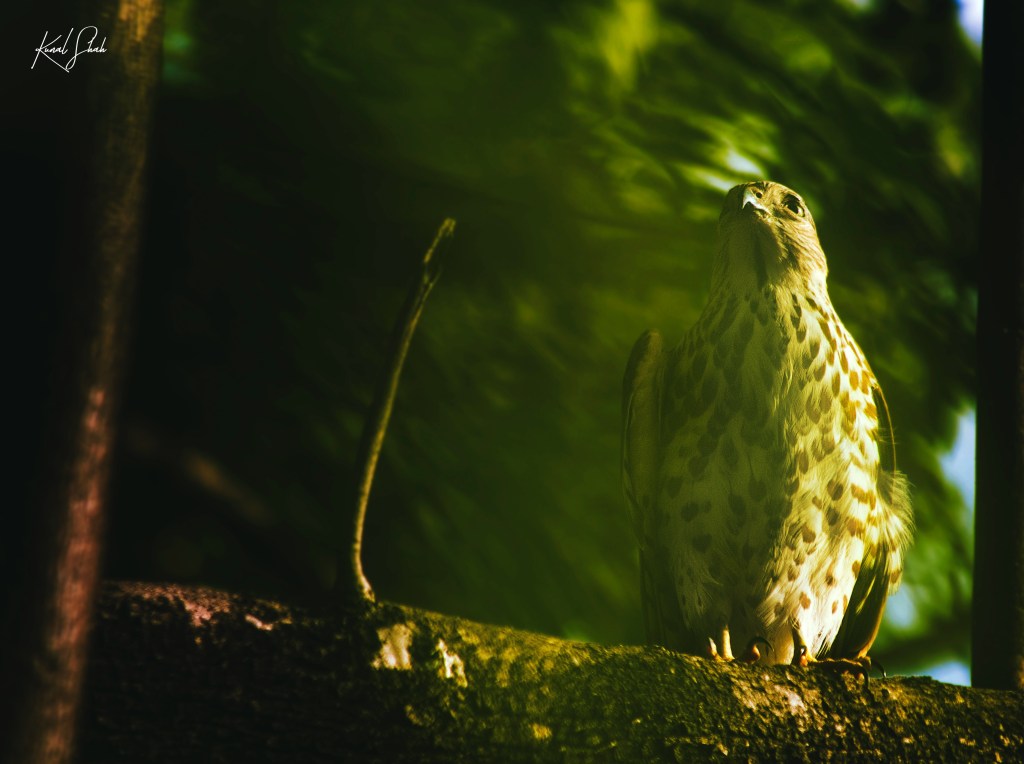
I was on my regular path looking for birds when I saw this immature Shikra sitting on a tree, at around 5.30pm. Now the first step when you see a bird that you’re interested in clicking photos of, is to find a good route with a lot of hiding spots for you like shrubs, to approach it without being noticed. You generally get low, even crawl like an earthworm if possible to go unnoticed. Now crawling here was not an option as it was sitting on a tree on the slope of a hill and I was on flat land, so I had to climb. But I kept my head low and approached steadily, like an undercover agent or FBI, like we always do. But what I noticed when I got closer was that this bird wasn’t bothered, at all. He didn’t even look at me. Well, it was a good sign. I clicked photos in that crouched pose and moved closer. Still nothing, not even slightly interested. I clicked photos from that position and again changed my spot to get a different angle. All movements done here were soft, like agents, just to not scare the bird. But the bird was not at all interested. It was VERY surprising. Now, I stood up straight. I changed angles, spots while walking like a normal person and this bird didn’t even care to at least see what I was trying to do. Birds might gain some level of confidence in you after a point of time, but it’s usually a long period. On the other hand, this kid was confident in me even before I arrived. I was walking here and there like a normal person trying to find different angles, I scaled up to a greater elevation to get to the eye level of the bird on the tree, wasn’t a great angle so I got down again, all like a normal person while walking on the crunchy leaves and sticks on the ground. This fella still didn’t give a damn.

Getting to the eye-level of the bird

Now this was funny. The only conclusion I could come up with here was that it didn’t know what a predator is and it believes that there’s no evil in the world. I’m not evil of course, but you gotta be cautious when you’re out there. At least that’s the normal behaviour of all the Wildlife that I’ve ever come across. I took out my tripod, set it up from different spots and angles, clicked ENOUGH photos. You won’t believe me, I don’t have a single photo of the bird looking towards me. I started shooting a video now. What I noticed after that was very interesting.

There were other small birds like Prinias, Sunbirds, Bulbuls, White-eyes, Robins and some flycatchers who were playing around and singing. Some birds were in the bushes behind me, some down the hill in other bushes while a few on the same tree as the Shikra, but on the branches above him. What I noticed was that this little Shikra was curiously listening to these sounds and searching where they were coming from. He noticed some Sunbirds chirping above him and tilted his head to watch them with utmost curiosity. He saw a flycatcher that took flight from the bushes behind me towards to the bushes down the hill and I literally saw the Shikra panning his head in synch with the Flycatchers flight. But not in a mood to attack (being a bird of prey) but with inquisitiveness. It was as if he was seeing the outside world for the first time in his life, he was seeing these birds for the first time, listening to so many different sounds and where they actually come from for the first time. He didn’t know what they looked like, he didn’t know what a human looked like, that there are real dangers in this world.

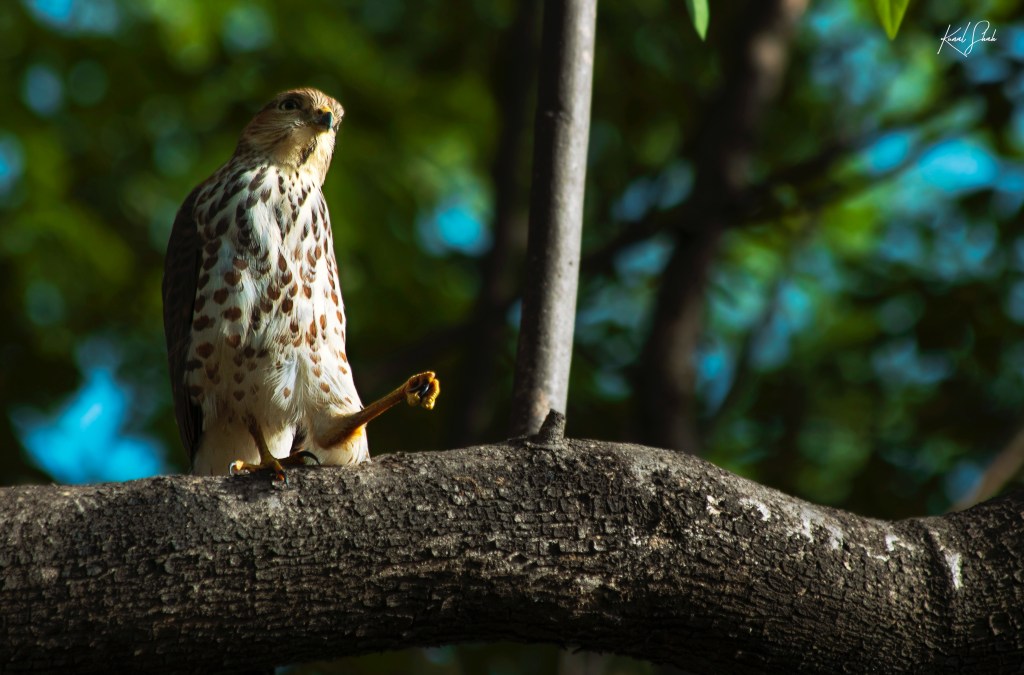
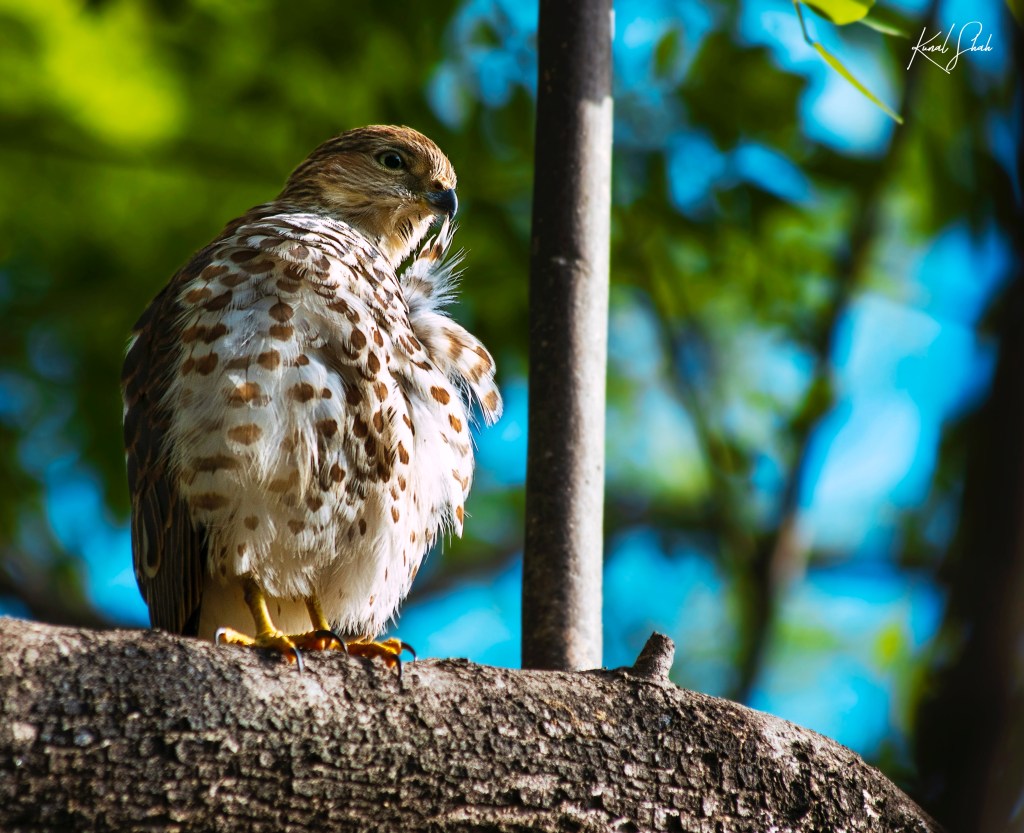
It seemed that it was all very new for him, that it was his first day out of the nest as an independent bird. And this is quite possible. Looking at his behaviour right from the moment I decided to approach him, his extraordinary boldness, his inquisitiveness for all the life around him, all the sounds, his relaxed body posture with one leg that he had pulled back in his feathers while he was standing on just the other leg, his ocassional preening and yawning while observing the nature around, his undeveloped but fresh feathers and plumage suggesting that he was just at the stage of leaving a nest. And that this was all happening after almost 4 months into the nesting season of the species(which is between March to June). All these things clubbed together pointed towards only one conclusion, it was probably his first day as an independent Shikra out of the nest in this huge deciduous habitat.

Stretching and Preening


I left him alone after I could get all the possible photos and videos, still no frame of him looking towards me 🙂

Here’s a small video clip of the various behaviours of the kid, preening, stretching, observing his surroundings are listening to all the sounds with utmost fascination- https://drive.google.com/file/d/1uoHexvY1DRzl-xwszrzRm7zdPLzyZxKe/view?usp=sharing

Here’s another one minute video about this entire outing(because this bird wasn’t the only thing I saw that day)- https://www.instagram.com/tv/CB2xX0AjC7r/?utm_source=ig_web_copy_link

At the start of the blog, I mentioned one of my previous blogs ‘The Invisible Bird’ where I talked about ‘The Hill’. You can read that blog here if you haven’t already-https://kswild.video.blog/2020/03/11/the-invisible-bird/

Hiking in the Western Ghats

One thing I like the most about Winter apart from the beautiful sunsets and wearing hoodies is the cold winter mornings. Most wouldn’t prefer to leave the warm, cozy blanket and get out of their houses on winter mornings. Trust me, it’s the same story on my side. I make plans at night, and in the morning at 4.30 am, I honestly feel like cancelling them all to just sleep under the warm blanket. But no, I beat this laziness for something better that’s ahead! I get ready real quick, have a warm cup of coffee and leave the house for an outing at around 5 am, somewhere in the woods, or the mountains, or grasslands, or maybe a combination of all – this place! The early hours are really very chilled and it’s completely dark around. But after sometime, there’s some light in the sky and the birds around start chirping. You see the beautiful mountains ahead, a single road leading you towards them, fields, grasslands all around. The sky keeps on getting brighter. The environment is still cold, but now it seems to be pleasant. You get out of your vehicle and walk towards a small quarry by the road to your left. The place is surrounded by distant mountains from all sides. To the right of the quarry are small birds like weavers, buntings, flowerpeckers playing around. You walk towards the right to click some photos of the birds when a Pied-crested Cuckoo appears out of nowhere.

The small quarry along the single road to its left, surrounded by grasslands and distant mountains (Photo taken from the right side of the quarry while facing the quarry, the birds in the story were singing and dancing behind me) (This is a photo from the Summer season, adding here to the winter story for reference)

(1) Baya Weaver female basking in the morning light, (2) A Green Bee-eater against the mountains to the left of the quarry, (3) Three Green Bee-eaters who were fluttering around, (4) A lone Wooly necked Stork resting on a tree against the distant mountains in front of the quarry in the cold morning temperature, (5) A scape of the same Wooly necked Stork

All the birds are fluttering around, singing and dancing in the cool environment, when suddenly, the sun just peeks from behind the mountains at the back. You turn around to see rays of orange falling on your eyes, the environment suddenly becomes warm, though it’s cool at the same time. The leaves of the trees glittering like gold, the orange-yellow-blue sky attracting you like never before. You take a deep breath to feel the freshness in the air. A Silver Cocks-comb flower in front of you by the quarry shining in the golden light, as if it’s wearing a golden coat around its petals, the rays of the sun passing through the small gaps! Such a pleasing view. There are some moments that you cannot describe in words however hard you try, those moments that you truly cannot forget in your lifetime – this was one of those. I tried to get a good frame of that moment in my camera, but the best one is framed in my mind. Lots of memories attached to this picture, the golden, shining Silver Cocks-comb flower I was talking about.

The Silver Cocks-comb flower (Celosia argentea) to the left of the quarry against the first rays of the Sun for the day

This is the beauty of the Western Ghats of India. I’m gonna take you on a journey, a usual Sunday morning outing at a place in the Western Ghats at the outskirts of Pune city in this blog. You just have to do one thing – just imagine everything, every single word. Try to create an image in your mind.

Spending around half an hour along the quarry in the warm light and in the company of small birds joyously singing around, welcoming the new day, it’s time to move further and explore. The sun rising steadily. A single road leading us to the mountains. The place surrounded by fields, grasslands, and the Western Ghats from all sides. We are headed straight along the path scanning the habitat, inspecting signs of bird activity. We see a variety of birds like the Yellow footed Green Pigeon, Black Winged Kite on our way to the Ghat section. The terrain changes as soon as we start scaling the Ghat. It’s a single path, a wall of huge mountains to the right, and a steep valley to the left. We arrive at a patch where the valley view to the left is partially covered by trees, allowing only a few gaps for the sunlight to penetrate. The area is cold and in the dark, under the shadow of the mountain wall and the trees. We can see a brightly lighted patch at  a distance where the road curves. Surprisingly, there is a lot of bird activity in this shadow region than the bright patch in the front. Birds like the Blue Rock Thrush, Robbins, Bushchats taking positions on the rocks of the Mountain Wall, on the small shrubs and crevices, where the penetrating light rays fall. ‌That’s when I saw this White Breasted Kingfisher on a dry tree, positioned just in that one ray of sunshine, giving me this dramatic photo. What a wonderful sight it was.

(1) The White breasted Kingfisher positioned in that one ray of sunshine, (2-3) Yellow Footed Green Pigeons perched on a tree on at the edge of the mountain against the valley

Moving on further, you reach the topmost point of the mountains from where the view is incredible. You yourself are on the edge of a high mountain, and all that you see around for miles is just tall mountains. This scenery changes every season. Being a deciduous forest – scrubland region, the mountains are all dry and pale yellow during the Summers. But the scape changes drastically in the monsoons, when you cannot get enough of these tall lush green mountains on all the sides with a dramatic cloud game. It is so beautiful. This place in the monsoons feels absolutely fresh and lovely. Post the monsoon season, in around December, the tall, grass covered mountains slowly start turning dry. They’re still green, but not as bright as they were. But they’re covered in lovely flowers all over them, an after effect of the monsoons. By the time April comes, the scape is yellow again, thus completing the yearly cycle.

View from the topmost point, in Summer vs Rainy seasons (Photos by my friend Viren Narvekar)

This place, during the monsoons, is an absolute heaven!

After getting a sufficient dose of the wonderful scenery from the view point, you start descending towards the land on the other side of the pass. Various birds of prey like the Crested Serpent Eagle, Oriental Honey Buzzard, Short Toed Snake Eagle and the guest of the monsoons – the majestic Black Eagle accompany you through-out the 10-15 minutes downhill journey.

(1) Crested Hawk Eagle of Pabe, (2) The guest of the monsoons, The Black Eagle accompanying us on the downhill journey, (3) The Downhill road- the mountains on the right side of the photo are just next to the ‘Pabe view point’

While exploring the land on the other side of the ghat, which again is surrounded by fields and grasslands on all sides, you come across a bird perched on a thorny Acacia plant in a field right next to the road. You identify it as a White-eyed Buzzard, but its not very close to the road to get a good photo. Which means, you either have to ignore it and move on, or get down and approach. Now, approaching the bird here is not easy as the field is flat with no trees or shrubs for you to hide while approaching the bird. This also means that you will be completely exposed and the bird would see you coming. But suddenly, your friend notices a deep trench in the land through which you could slowly, quietly get close to the bird without it noticing. And you do exactly the same, get close enough to the bird through the trench till you could see it clearly. After clicking some photos from this spot, the only two options you have are – 1) to approach the bird in the open because you’re at the end of the trench. But now you’ll have to approach it from an even closer distance than earlier. Or 2) you could turn back. What would you do?

Well, we took our chance and decided to steadily approach the bird in the open. We took a lot of time, moving steadily like an earthworm, so that we don’t scare the bird. The bird gained enough confidence in us and stayed. At a point, we decided to stop and give the bird its space. We clicked some photos from that spot and returned to our vehicle. This was a very cool approach to a bird of prey. 

Photos of the White-eyed buzzard clicked from the open land after the trench

It was a fun outing. We traced our path back towards home, but not without one last stop in-between, to visit the Master of Camouflage.

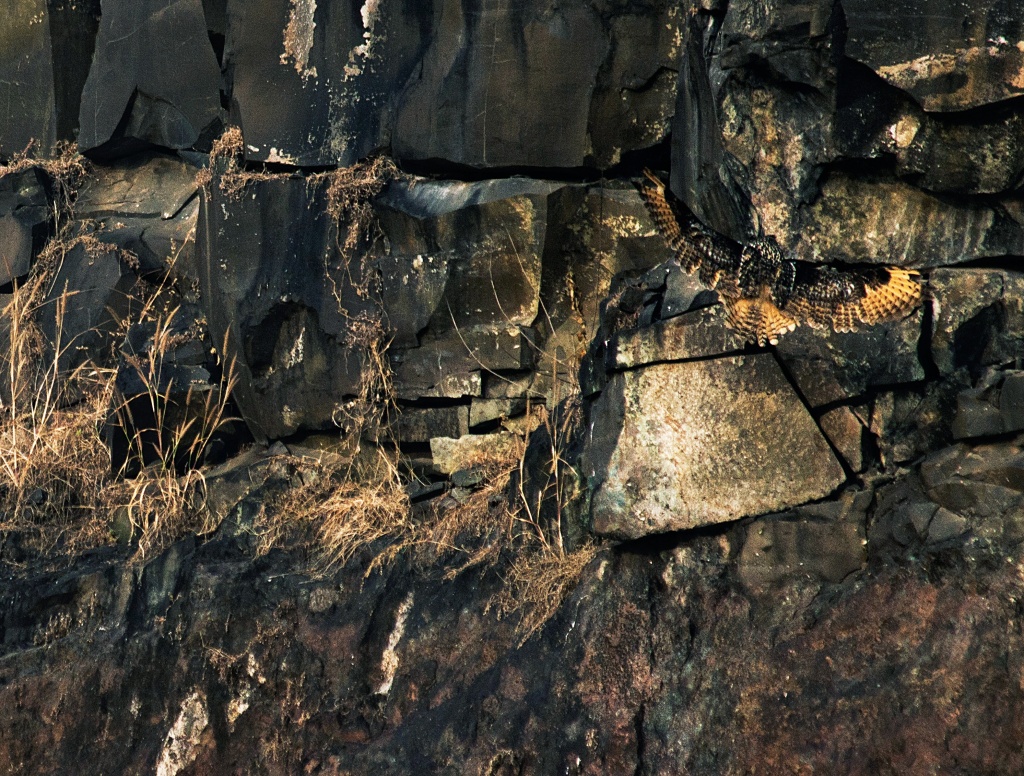
We halted at a random quarry – not the first one from this blog, this one was different. We picked up the binoculars and started scanning the stone walls of the quarry. And there he was, covered in dry grass, resting in the shade along the wall peacefully. The Rock Eagle Owl or the Indian Eagle Owl. Lapwings and egrets were sitting on rocky islands in the lake of the quarry, totally unaware of his presence. Even Pigeons and Mynas were sitting on the quarry walls completely clueless. Such is the magical camouflage of this surprisingly huge bird (19-22 inches). Spotting this bird isn’t easy, but when you do, the happiness and excitement is ineffable.

The outing had paid off! 

The Eagle Owl covered in dry grass, resting in the shade along the walls of the quarry. It’s there in all these pictures, the question is, can you see it?

This place in the Western Ghats is beautiful. It is so close to the city, yet feels like a different world altogether. The Wildlife here is very rich and you never know what you’ll see. This was just one short morning outing out of the many. Cannot wait to go back to this place post COVID-19, I’ve already missed the Summer here this season. Hope I don’t miss the monsoons.

Chaos

This definitely is one of the best experiences I’ve had in the wild so far. After a ‘not so active’ birding session, I decided to settle by the marshy land near a small pond. There were reeds at one side of the pond, towards my left, which is a perfect spot for waterbirds to hide. A ‘Pond heron’ was perched on a lump in between the reeds, fishing, and a shy ‘White breasted Waterhen’ was cautiously moving along the reeds probably looking for food.

Two ‘Red wattled lapwings’ were sipping water, standing on the marshy mud at the opposite side of the pond from where I was sitting. A ‘Little Cormorant’ was sitting on the rock to my right, basking in the sun. All these birds were doing their own thing peacefully and I documenting everything silently from a perfect spot.

A Common Sandpiper sitting at a further distance from the scene, basking in the morning sun

Suddenly, a ‘Shikra’(a small bird of prey) raced in out of nowhere and settled on a tree close to the Pond Heron, just behind the reeds. This caused a lot of chaos. The Waterhen ran into the reeds, the Lapwings started shouting at the top of their voices and to my surprise, even the Pond Heron panicked. Lapwings go nuts for even the slightest reasons, so that wasn’t much of an awe, but I wasn’t expecting the Pond Heron to go crazy. The Pond Heron is a huge bird compared to the Shikra. It appears to be very small because it always sits pulling its neck completely in, but the Shikra freaked him out so much that it raised it’s long neck as much as it could, the feathers erect as if it had suffered from an electric shock, trying to appear big. I had never seen a Pond Heron in this mode earlier. It occasionally looked here and there, then at the Shikra followed by an alarm call.

The Pond Heron in its freak out mode.
How a Pond Heron casually sits, with its neck tucked in. (Photo of a different individual from an earlier outing)

All the birds were on high alert. It was really fun as well as thrilling to observe this from such close quarters. At one instant, the Shikra just dived in the reeds and back, which totally stopped the heartbeats of all the birds for a second and the calling intensity rose the next moment. The Pond Heron took a flight and settled next to the Lapwings. The Shikra took another dive, this time in the water behind the Lapwings. That was it, all the birds shouting flew away for their lives except for the Cormorant who was the silent observer all this time. I was really excited. The Shikra started drinking water and I filming, when I sensed a slight movement right next to me. I instantly turned my head(the camera still pointed towards the Shikra) and what I saw next left me stupefied for a moment. It was a huge Rat Snake which had slithered by my side from such a close range, without me noticing it. Thankfully I paid attention to that slight ‘Spidey sense’ and turned my head. I immediately panned my camera around, which was handheld and tried to get as much of the snake as possible in the frame before it vanished into the rocks. (I have it recorded in a video, couldn’t attach it here directly. So I’ve added a link of the video at the end of this blog)

The same Shikra that made the other birds go nuts. It’s a female, all dirty after a dip in the muddy water.

I couldn’t process what had just happened, with all these events taking place so quickly. I just sat there for a while thinking about everything that I had witnessed. It was peaceful before the Shikra arrived, after which it all happened in a flash. My ‘not so active’ birding session turned out to be so fruitful in such a short span of time. Anything can happen at anytime on the field. At one moment you’re having a dull day with the sightings and you see something maybe totally unexpected the next moment. You just have to be at the right place at the right time. Even small decisions can totally transform the day. Say I wouldn’t have decided to sit by the pond and had explored a different area instead, I wouldn’t have had such a lovely sighting. Maybe I could have had a better one, or nothing! Who knows? It’s about taking chances and doing what you are doing with dedication, persistence and patience. You’ll sure earn the fruits at some point. Nature has taught me so much, unknowingly, through such outings 🙂

Also, I should have captured a wide angle image of the scene, just to give you an idea of the place, the atmosphere and for you to connect more. But then, who knew, didn’t think of this a year ago. 

Link to the video when I was filming the Shikra taking a dip and suddenly panned it towards Rat snake-

https://drive.google.com/open?id=1RxlyLEqMyOK7UOXQ5aC7poOHvSbC2e_u

It was Totally Unexpected!

Non-birding outings are the best birding outings.

They totally are! Because you’re not expecting anything in particular, you’re just there to relax and have fun. Anything that you see is just a bonus, because you’re not really looking for wildlife. There’s no scope for disappointment at all. 

I was out with my friends on The Hill. You guys remember The Hill, right, from my previous blog (‘The Invisible Bird’). The Hill is a hill around my place in Pune city where I’ve been going since childhood. It’s the place where I started birding and photography. Read more about it in my previous blog, but after reading this story of course.

So we were sitting along an old, abandoned stone quarry on The Hill, chatting, talking about random stuff, laughing. It used to be a stone quarry many many years ago, probably before I was born, I don’t know. Over the years, a beautiful scrubland habitat formed inside the quarry that became home to a variety of wildlife. We were just enjoying the peaceful atmosphere, facing the lovely valley view. There were two Peacocks on the opposite end of the valley, chilling on the edge of a dry deciduous forest on the other end. They were sitting at the same spot for hours, just like us, chatting and laughing maybe. We could also see a pair of White Breasted Kingfishers doing something in the forest. They were far away. There was a Black Redstart, male bird, jumping on the walls of the quarry. Out of no where stepped in a completely melanistic(black) domestic cat in the quarry. We were watching it from the top. It looked like a mini Black Panther walking into the scrubs. We moved on, completely lost in our conversations. After a while, I saw the same cat looking at us from a close distance. I don’t know when it climbed the hill, but it was like a wild experience, a mini Black Panther looking towards you through the dry grass. However, there was a stray dog playing around us who also spotted it and chased it away. 

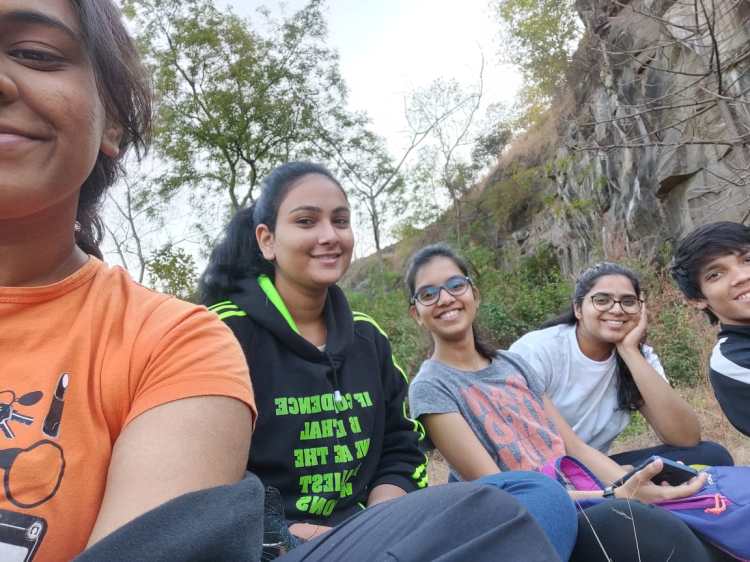
Here’s an ugly picture of us. Adding this just because my friends wanted a mention in this blog. Are you all happy now?

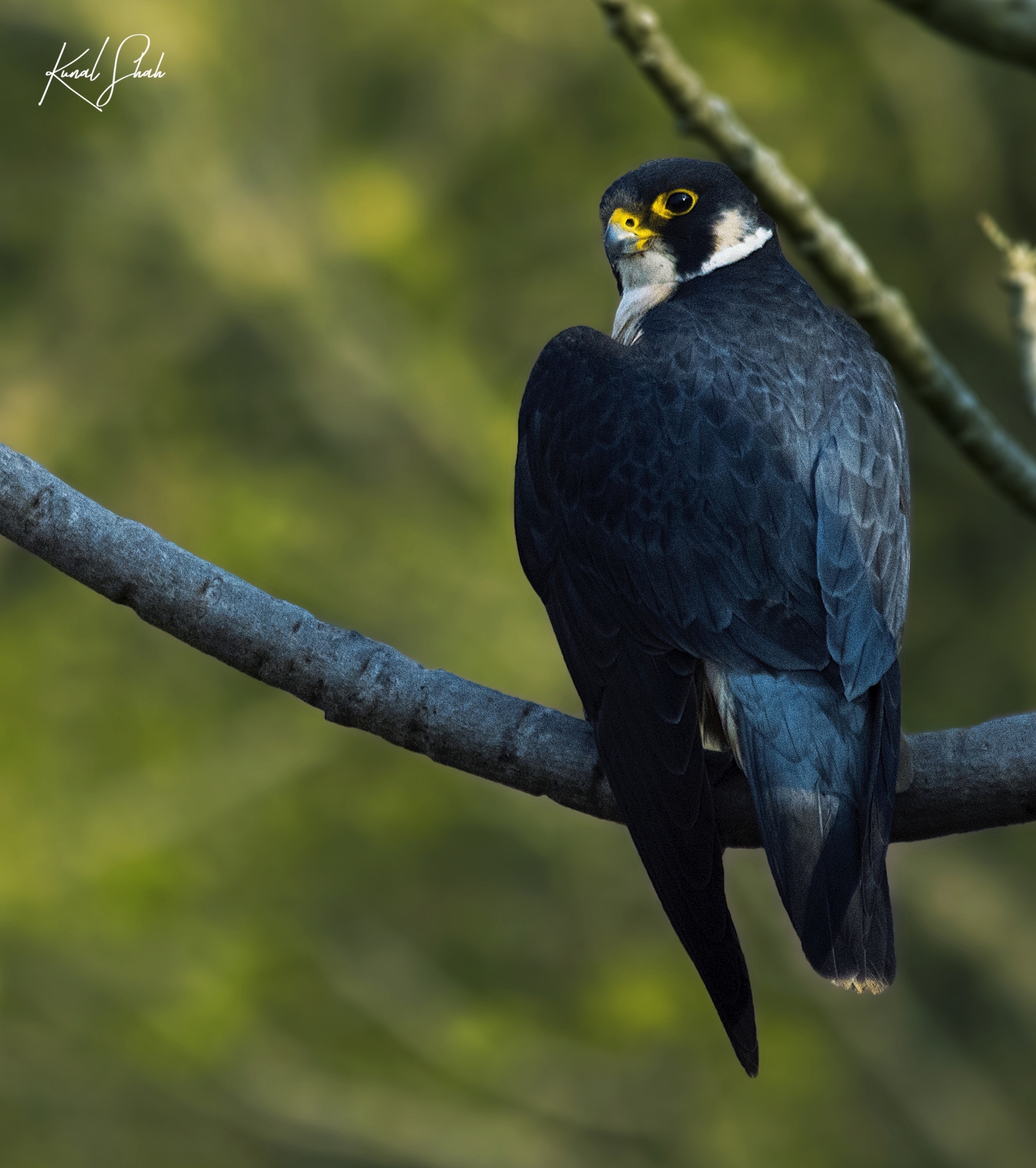
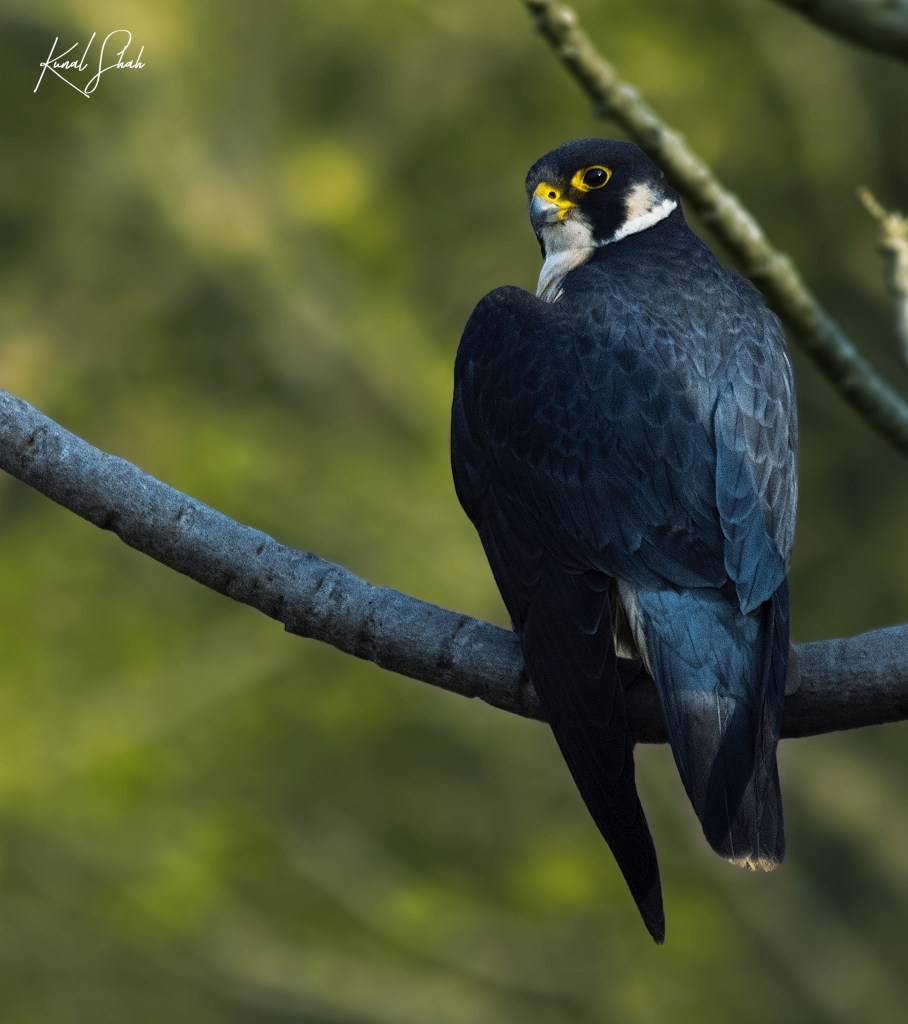
We carried on with our talks. All of a sudden, something dived from the rocks of the quarry and flew right over us with astonishing speed. That was the time when the birder in me woke up. The bird took a U-turn and came back and I realised that it was a falcon! A Peregrine Falcon! A rarity! The fastest flying bird in the world! I crossed my fingers and started chanting ‘please perch perch perch perch perch…’ and it perched! On a short dry tree at the top of the hill, along the edge of the quarry. I thought to myself, ‘Oh my God, I wonder where my luck is going today! Thanks to all the superpowers out there’. 

We weren’t exactly at the top of the hill though. Rather, it was the edge of the quarry,  just a few meters below the top. I never usually pick up the camera and chase a bird when I’m with my non-birding friends, but I had to do it this time for it was a Peregrine Falcon! I immediately started clicking photos but it was far away and it was actually sitting diagonally upward to us. So the background was completely white due to the sky. But I couldn’t complain because this was the first time I saw a Shaheen Falcon perched! Yes, I realised that it was not a Peregrine Falcon but it’s twin brother, the Shaheen Falcon. But it was still a rarity! 

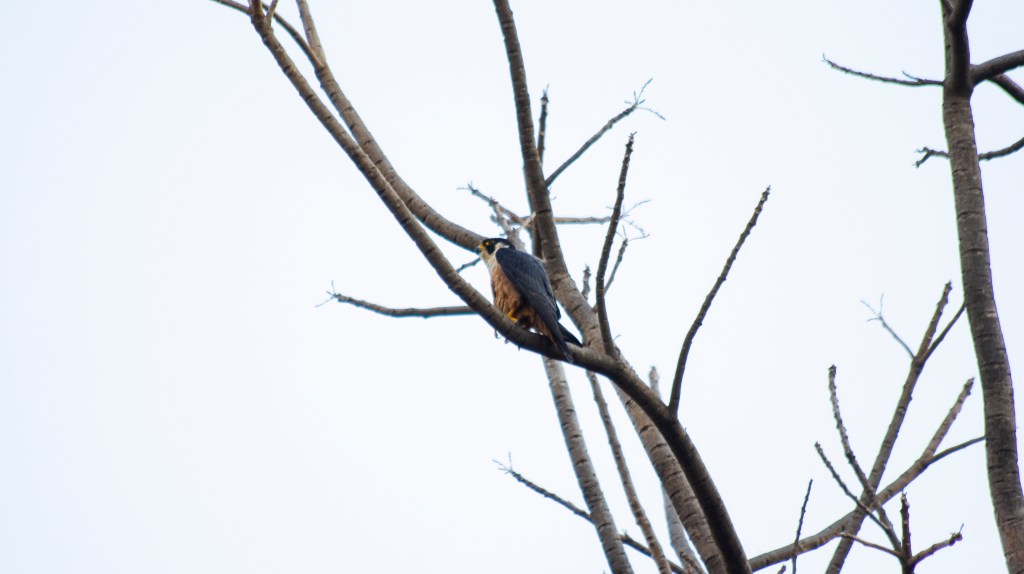
I tried to click as better photos as possible, though all were just record shots. A record shot is an okay-ish photo, just a proof that yes I saw the bird. 

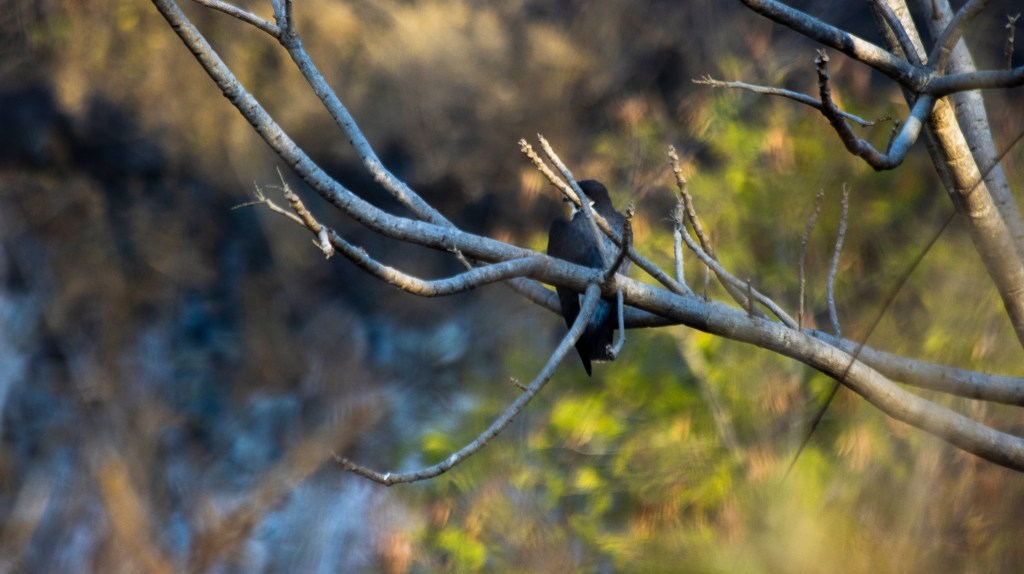
Record shots of the Shaheen Falcon from where we were sitting (uncropped)

One of my friends asked me, “why don’t you go up the hill?” It hadn’t clicked to me before! Without saying a word, I immediately turned my back and ran to find a way to climb to the top. I had to go in a huge circle to make my way up the hill through the forest behind us, without the bird being able to see me. When I was finally on the top, I slowly crawled towards the bird. Clicked photos, crawled again and the same. 

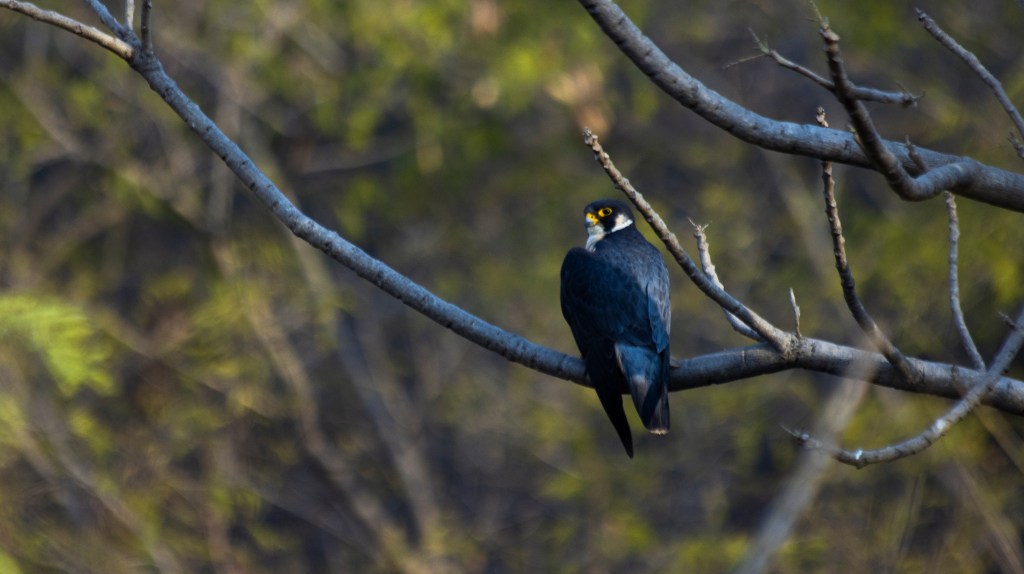
The first few photos I took of the bird when I climbed to the top (uncropped)

I took my time to approach the bird very carefully, very patiently. I didn’t want to startle the bird. You never know when and if at all you’d get an opportunity like this again. And that too on The Hill!

This is how I slowly approached the bird. (Uncropped)

Now,  the situation became very tough. I was on the sloping edge of the quarry with the slant towards the valley. The grass below me was not grass, it was just ash as people had already burnt it. The bird was right in front of me, almost in an open view, just a small shrub covering me. I was unbelievably close. But I had a choice to make here, either to crawl straight where the bird would be on a completely open perch without any obstructions, but the sloping way would narrow down even more and I would actually be on the extreme edge of the Valley, one wrong foot and I’m gone. Or, I could climb to the other end of the slope and crawl from there, but then there would be a lot of movement visible to the bird and the bird would also not be in complete open sight to me. It was a tough choice and I had to make a quick call. 

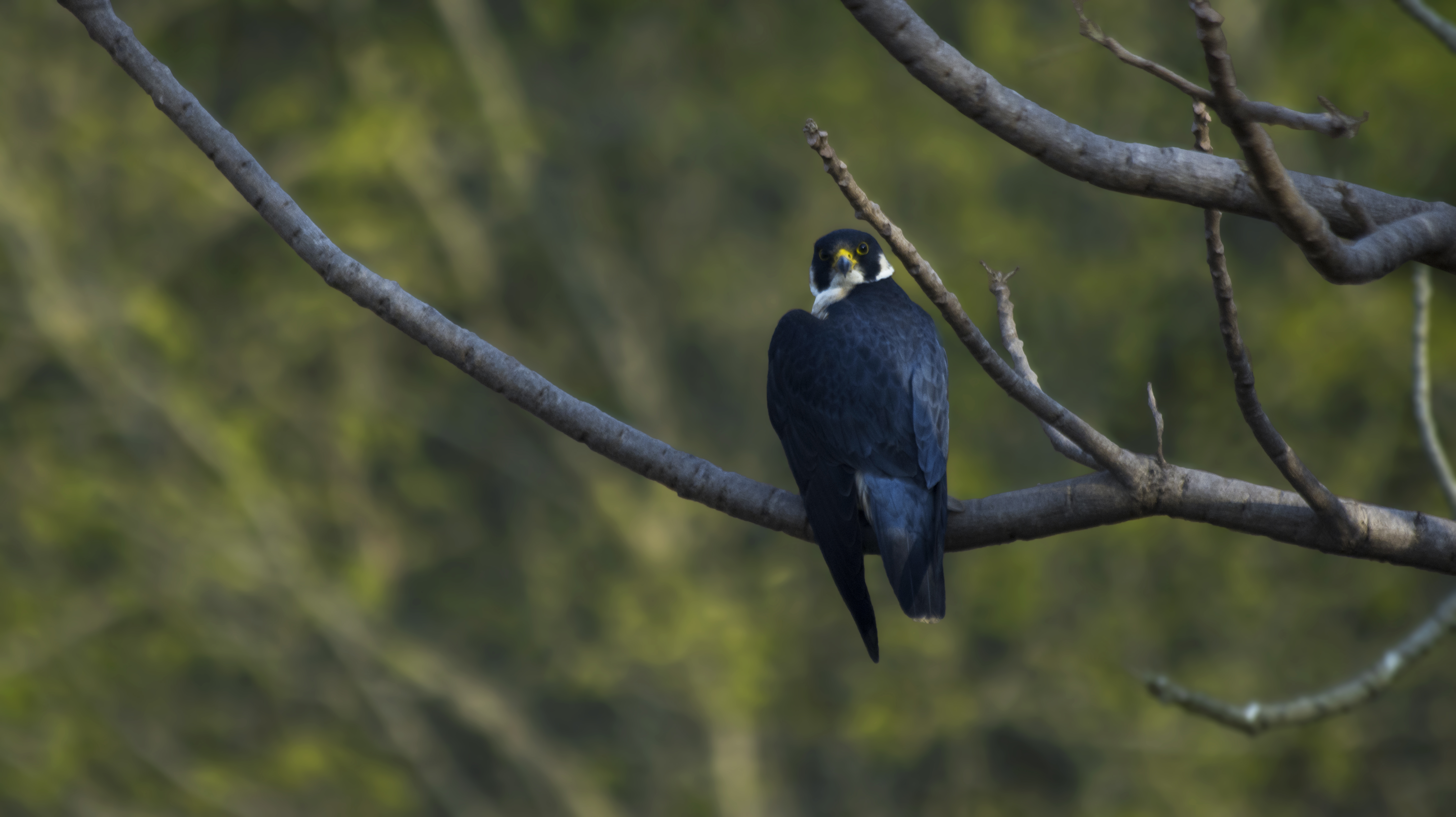
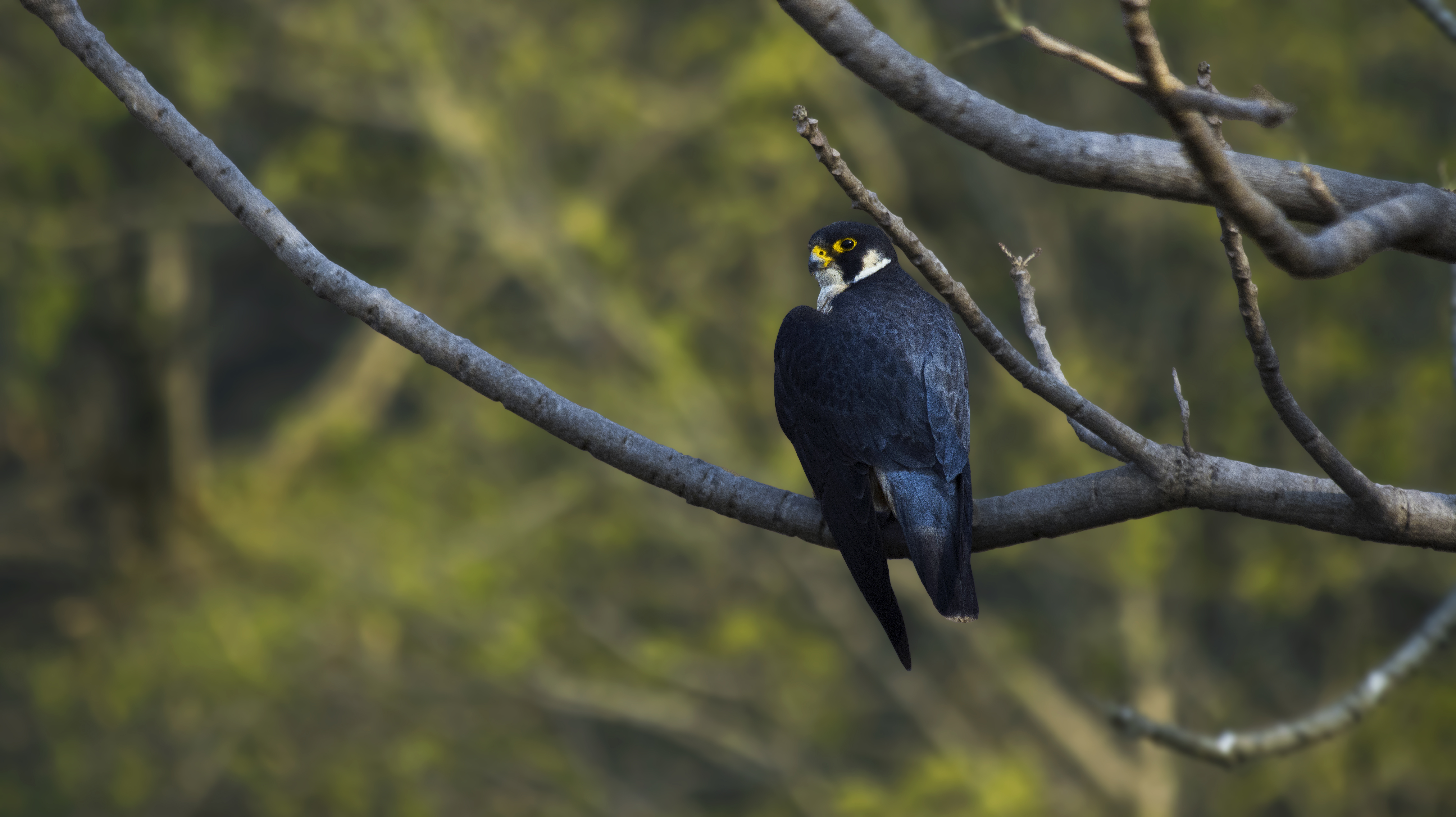
Ofcourse I went with the second option, I love my life. And as expected, the bird noticed a lot of movement and took off. But I was completely satisfied with this entire episode of around 40 minutes! Yes, it sat there for almost 40 minutes! This was one of my best approaches to a bird, that too a Shaheen Falcon, that too on The Hill! I had seen this bird many times on The Hill since childhood, but in flight. It was my long wish to see it perched someday on The Hill, but I never expected that it would be such a close encounter! I mean, look at this photo, it was clicked at just 300mm. 

I’m sure this is one of the best photos of the bird from The Hill. My birding friends from Pune city went crazy after seeing this photo, they couldn’t believe that it was from The Hill.

When I left my home that morning to chill with my friends on The Hill, it never crossed my mind that something like this would happen. But here I am with this photo and a lovely story behind it to narrate 🙂 

Life is unexpected. However hard you try, how much ever you run behind things, somethings just won’t happen. And, one fine day, when you least expect it to happen, life opens all doors for you. 🙂

With that said, I’ll see all your smiling faces again in the next blog with some more new stories. Till then, take good care of yourselves and your close ones, remain isolated, follow all the instructions issued by the government and other authorities and wash your hands 🙂

#Corona #StaySafe

(If you wish to read more about The Hill, you can read it in my previous blog here- https://kswild.video.blog/2020/03/11/the-invisible-bird/ )

The Invisible Bird

Back when I was in fifth grade, the time when I started birding, smartphones weren’t that common, everybody didn’t have them. Kids, definitely not. The primary social networking site that people used was Facebook. My friends were underage but still had Facebook accounts that they operated through computers at their homes. I wasn’t on Facebook, I don’t even remember if I had a Gmail account back then, probably not. There was a popular Facebook group(and it still is) called ‘Birds of Pune’ that I used to follow through my mom’s Facebook account on her phone.

I had just started birding and I used to be amazed on seeing awesome bird photographs clicked by people, that too on a hill which is very close to my house. I used to hardly visit that place then(which is not at all the case now, it’s my second home and people feel that I live on the hill now). People used to click amazing photos of some rare birds there and post on the Birds of Pune(BOP) group. I used to be so surprised on seeing those photos because I myself never saw anything whenever I went there. I used to wonder where people saw all these lovely rare birds and why I never saw them, leave aside photos. I used to use a small matchbox camera back then, those that fit into your pocket. Those hardly had any zooming range and quality. People used to post pictures of a lot of different kinds of birds from that hill that I had never seen there. The photo of the bird that awed me the most was that of a Nightjar.

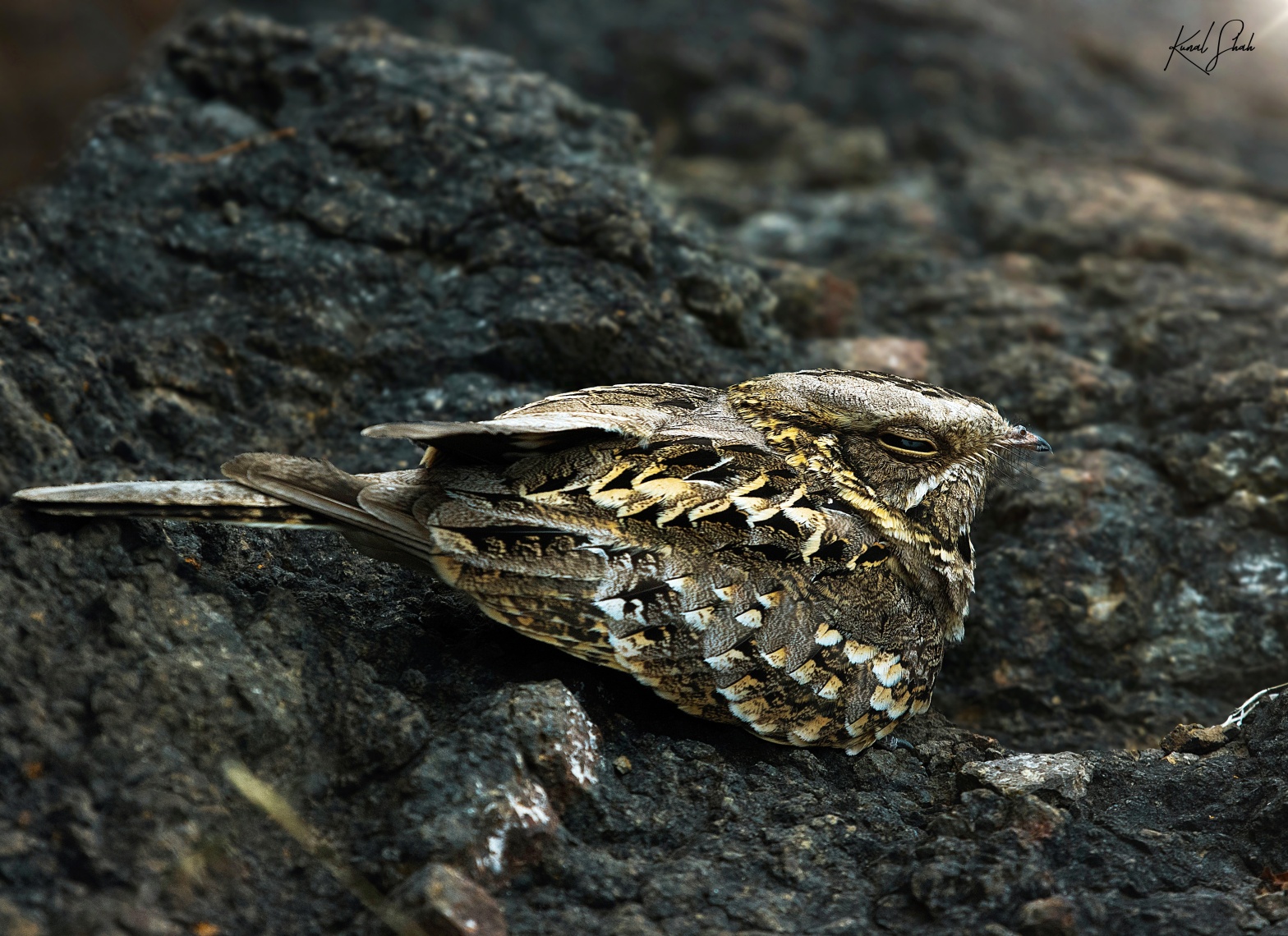
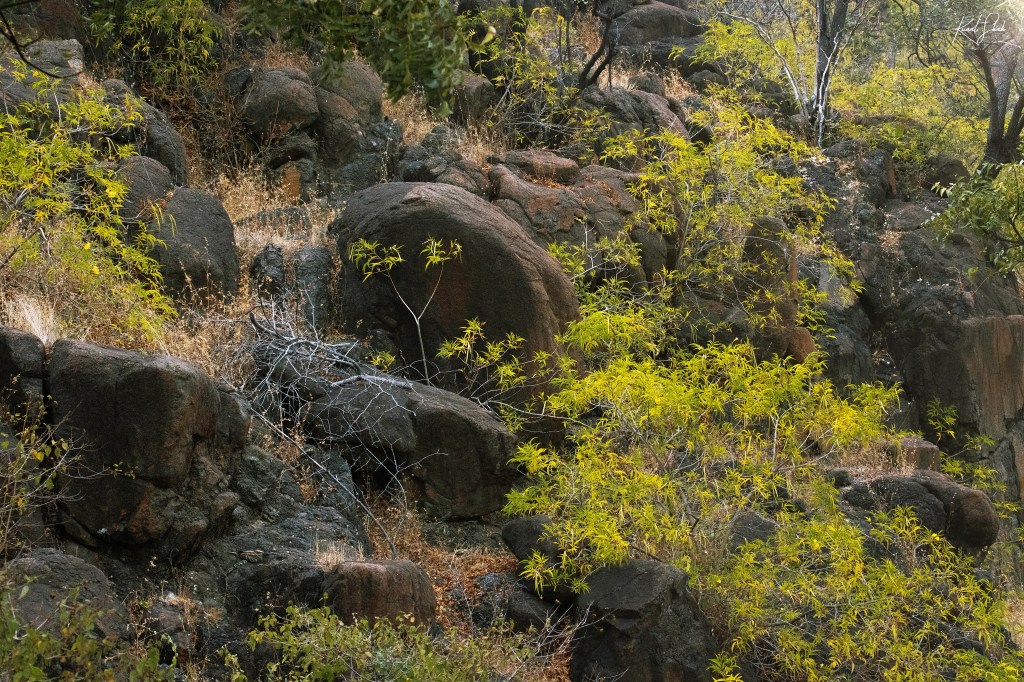
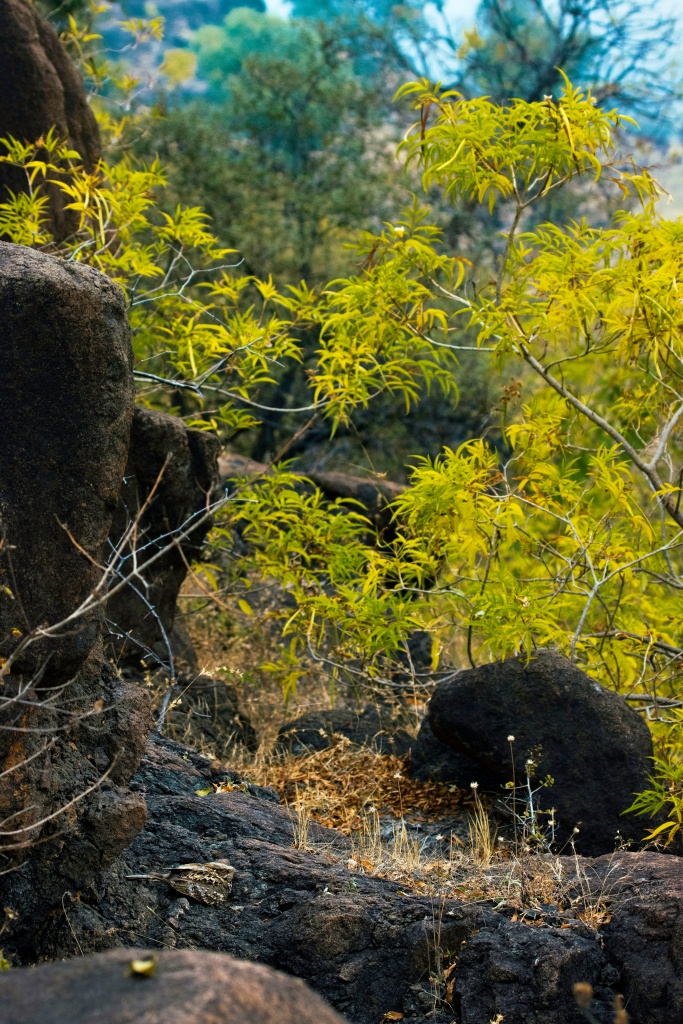
A Nightjar is an extraordinary creation of nature. Trust me, even if that bird is sitting right in front of you, you won’t be able to see it. It is literally an invisible bird. It has one of the best camouflage in the avian world. It mostly sits on the ground and its colour and texture match exactly with its surroundings. You won’t believe what an amazing camouflage this bird has until you see one. Because when you see one, you’ll argue with me for a while that it is not a bird but a stone. 

See the camouflage? It’s actually much easier to spot it in this photo because of the zoom and as it was perched on a very revealing spot which is almost never the case.

A Nightjar is a nocturnal bird, that is, it rests at one place the entire day and gets active after sunset. So if you spot a Nightjar during daytime, it won’t move even an inch from that spot until sunset, unless it’s disturbed of course.  But the very first challenge is spotting one during the day, lol, because it’s almost impossible. And it is such a confident bird that even if it is present around you, it won’t fly away because it thinks that you haven’t seen it yet. That’s the reason why Nightjars allow people to come to a closer distance compared to other birds and don’t fly away. 

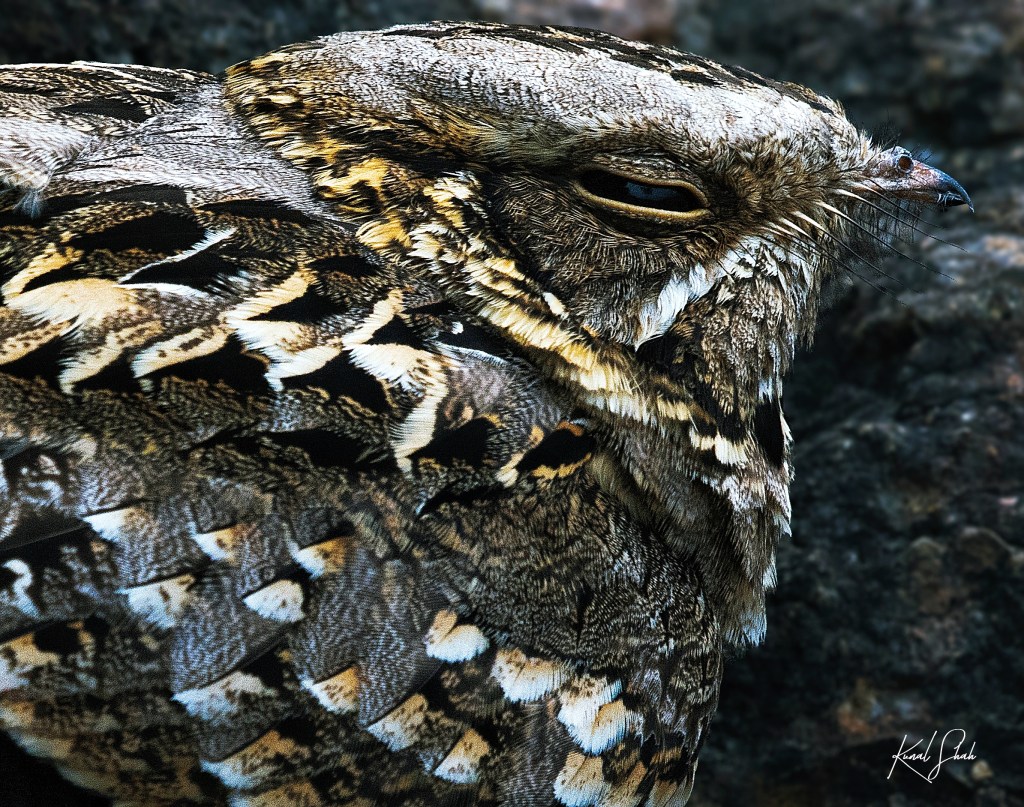
Now the thing that struck me about the people from BOP is how the hell did they see a Nightjar on the hill and how the hell did they get such crisp closeups. I had never ever seen such closeups of any other birds, except Nightjars (today most people have telephoto lenses so this doesn’t apply now). And I had just started birding then, so I didn’t know anything about birds and their behaviours. Naturally I didn’t know that nightjars don’t fly off that easily. And at that time, I was very much fascinated with extremely tight frames, crisp, sharp closeups of birds with every single feather of the bird sharp, and headshots and eye shots of birds. Today, I’m not. You know that if you follow me on Instagram (@ks_wild). Why not? Well that is a different story. 

Anyway, I always had this thing in mind since then that I want to spot a Nightjar by myself in broad daylight and get those crisp, sharp closeups and headshots and eyeshots.

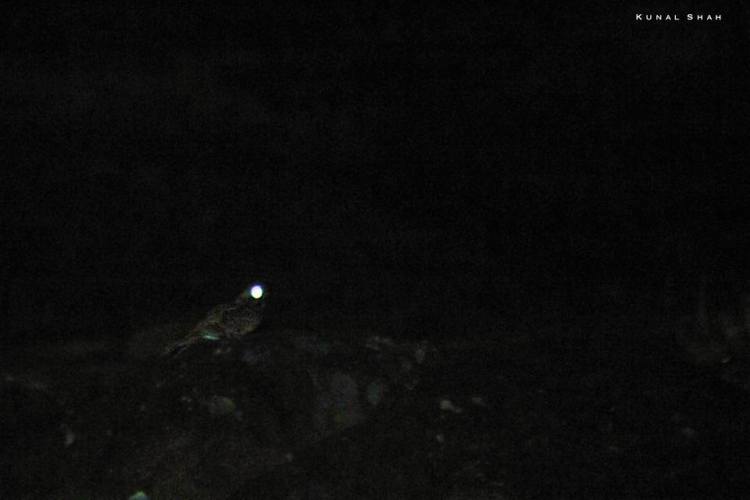
Three years back, I used to go to the hill after sunset to monitor Nightjars for a week. That was when I saw a Nightjar for the first time, and not just one, but around 3-4 different individuals. Of course I didn’t see it in broad daylight but under a torch light and of course I didn’t get good photos except distant record shots. So my dream of monitoring Nightjars was fulfilled and I’m gonna write another blog about that later. But my dream of spotting one during the day and getting those specific shots was still incomplete.

Indian Nightjar from the hill under the torchlight at around 8pm (no flash used). A blog about the entire monitoring experience coming soon!

I never really saw a Nightjar on the hill during the day ever, maybe because I didn’t search for it enough. And spotting a Nightjar elsewhere around Pune city was out of question because I hardly went to any other places for birding due to transportation issues as those places were far away. So I had never ever even seen a Nightjar properly. 

Until recently, I went to another place around Pune city for birding. I was very firm on my decision of finding a Nightjar that day! I searched A Lot. I walked A LOT in search of a Nightjar on scrublands along hills and mounds, in the freezing cold weather of an early Winter morning. I started from a flat land and had reached the top of a tall hill at the end of around 2 hours or more, when I decided to turn back empty handed. My friends who were with me said that let’s trace back the route by which we came here, to climb down the hill, as we were not quite familiar with the place. But I wasn’t quite satisfied with the sightings that day and I always thought that if we walk a bit further till the patch of land that’s in front of us, we might get to see something. I had been doing this from the time we started exploring that day, that let’s walk some more and we might see something, which had led us to the top of this hill. I asked my friends to just walk a little bit more towards the front and then start climbing down from there so that we also get to explore that patch rather than just tracing the same path backwards. They agreed, we explored that patch, saw nothing and started climbing down from there. 

And just as we spent 2+ hours without any ‘great’ sightings and without any Nightjar as well, a miracle happened while we were climbing down. An Indian Nightjar flew from just a few meters away from me, exactly at the moment I saw it. I was excited as well as alert at the same time because once the Nightjar settles down, it would be impossible to spot it again. I tried to track where it went but couldn’t locate the exact position and only the area where it flew, which was half way up the hill. We climbed back and tried to find the Nightjar, but now it was even more difficult as I couldn’t even locate the area where I saw it settling. This happens a lot of times when on field.I tried to guess the area and find the Nightjar. And you wouldn’t believe me, it was sitting on a rock exactly in front of me, at a distance. We were so so lucky to find it perched on such a huge rock without any kind of obstructions like grass or shrubs covering it. It was completely in the open. It was far away and to get some good photos, we were gonna need to get close enough to the Nightjar. 

Indian Nightjar on a complete open perch on the rocks

But I knew that we could not hurry here, as the Nightjar had just flown to this position and it was quite alert. We would have to give it a lot of time to settle and to go back to normal before we could go close. I made it very clear to my friends that we are not gonna hurry, we are gonna stay here for a long long time and get close to the Nightjar step by step. And that’s exactly what we did. 

We could have directly gone to that place in less than 2 minutes because it was not that far away in reality, just far for the camera. But we played around that area for one and a half hour, tactfully deciding our route to approach the Nightjar and then setting up checkpoints in between. As in, first we will go upto that rock, click photos from there, wait for 20 minutes, then go to that tree, wait there for another 15 minutes and so on. Now to avoid a direct approach and getting in sight of the Nightjar, we decided such an approach that we would get something in front of us always to cover us, such as a huge rock, a shrub etc. For that, we had to climb the rest of the hill again, walk a few steps and get down half way again. 

Over a course of one and a half hour, we reached to an UNBELIEVABLY close distance to the Nightjar without making it fly away. All because of our planning of a very patient and tactful approach. My dream of spotting a Nightjar by myself in broad daylight and getting crisp, sharp closeups and headshots and eyeshots was finally completed after almost 8 years. Now, the photos that I had dreamt of back then when I was in 5th grade don’t have much value for me today because I don’t believe much in such tight frames anymore even though I still like them. But what I’m happy about is that what I had dreamt of when starting birding has been finally fulfilled. This is an achievement for me! 

Finally got those closeups that I had dreamt of when I started birding eight years back

Had we traced back our original path to get down the hill, we would have not seen this Nightjar and returned home empty handed. It was just that inner voice that I trusted and made a quick decision of walking for a while and getting down from a different path that we saw the Nightjar. There’s a very important life lesson hidden here kids, every small decision you make, every small step you take might change your life forever. (How I met your mother reference, get it? Haha)

I still haven’t found a Nightjar on the hill yet, in daylight, but that’s just because I haven’t tried. But now I am going to! And I’m very positive that I will find it, soon 🙂

Well, this is the end of this blog, but I would like to add an important point here. As I said, Nightjars are nocturnal birds and they rely totally on their camouflage during the day to hide from predators. That’s the reason why they’ll sit at one place the entire day without food and water, even in the hot scorching heat of the Summer. So if you see a Nightjar during the day, don’t go very close to it until it flies away. Maintain enough distance. And by enough, I mean really enough. You don’t want to disturb the bird, disturb it’s camouflage and let predators spot and hunt it, just because you wanted to get photos. Birds come first, photos later. When I said ‘UNBELIEVABLY close’ in the blog, I meant in comparison to when we approach other birds. These closeups here have been clicked at 330mm using my friend’s telephoto lens and have been cropped to a great extent, that’s why they feel closer than what we actually were from the bird. So please please PLEASE don’t go and try to pet Nightjars. They are wild birds and not domestic dogs, please maintain a good distance. With that said, I’ll see you all in the next blog 🙂

Birding in The Valley: Part 2

Hello, welcome back. How have you been? Do you remember the Barking Deer story from my last blog called ‘Birding in The Valley: Part 1’ (which was actually a continuation of the blog previous to it called ‘The Valley’) ? Well, this one is a continuation of that blog. So it’s like a tri-series, three blogs to complete one long yet interesting tale. Haha I’m sorry, but I cannot help it. There’s so much to tell, so many experiences to share from The Valley. I’m trying to filter out just a few interesting ones, but even that isn’t an easy job for me. So I request you to go through the previous blogs if you haven’t already, before starting this one, so that you can get in the flow.

Here’s the link to my previous blog, that is, the second blog from this series, ‘Birding in The Valley: Part 1’ : https://kswild.video.blog/2020/01/09/birding-in-the-valley-part-1/

And if you haven’t read the first blog, ‘The Valley’, from this tri-series, you can read it here: https://kswild.video.blog/2019/12/25/the-valley/

Indian Paradise Flycatcher rufous male in the forests of the Valley

Flower Chafer Beetle (Chiloloba acuta) from the fields of The Valley

Remember that different patch of the forest that I was talking about in the previous blog? The one which kinda looked like a rainforest from Hollywood movies? This tale is from the same patch, just after the Barking Deer incidence. There was no sign of sunlight penetrating through the dense cover in this special patch of the forest. But it did over a few rocks at a distance with creepers around, typically like in movies. The Barking Deer I talked about came running down the hill-slopes in the patch of the forest just behind these rocks. It’s kind of like an open patch in the forest, very well covered by trees but still having a lot of running space, unlike the rest of the forest. I don’t know if you can imagine that, but its literally like the ones we see in Hollywood movies. 

Forest Calotes (Monilesaurus rouxii) male(left) and female(right)

There were many Calotes and lizards around. One such brightly coloured male Forest Calotes was sitting on a creeper. Now, we just saw this brightly coloured male sitting on the creeper, initially, just like you did in the above photo. What we didn’t realise was that there was an amazingly camouflaged female Forest Calotes as well right next to the male. A very interesting ritual was going on there, the courtship ritual. The male was doing pushups to impress his girl. Yes, pushups! Male Forest Calotes do pushups to attract the females. They develop this bright coloration in their breeding season which is around Summer. They have a small fan like flap on their necks which they blume while doing the pushups. They bob their heads and even raise their bodies up and down. This particular male even tried to grab the female forcefully twice or thrice, in vain. It was such a wonderful experience and the habitat around made it even more interesting and memorable. Couldn’t get many photographs in action as there wasn’t much light. Nevermind, I have the moments etched in my memories forever, truly. 🙂

At the end of this blog, I’ve added a link that’ll take you to a short video that I made in the Valley. You’ll get a glimpse of the Forest Calotes male doing push-ups in that video. So don’t forget to check out that video at the end.

Forest Calotes male (Monilesaurus rouxii) from that different patch deep inside the forests of The Valley doing push-ups to impress the female

If you’ve visited the Western Ghats during Winter, you definitely would have seen small cotton like entangled threads at the base of trees, bamboo, in rock cavities and stuff forming a funnel/hole like structure. You can see a lot of these in the forests of The Valley.Ever wondered what it is? How is it everywhere? Who makes it? The creator of this funnel is a small Spider called the Funnel Web Spider or the Funnel Weaver Spider. Not just the Western Ghats, these Spiders are fairly common throughout India and are present in huge numbers. Their web is spread over a much much larger area than their own size and there’s a small funnel at the centre. This is where the spider resides. The larger, non sticky web is built for the prey to get entangled in the threads. These Spiders are lightning fast sprinters. Whenever a potential prey lands on the web, the spider senses the vibrations and rushes to immobilise the prey with its venom. Then it drags the prey into the funnel for a feast. Don’t you worry, almost all Funnel Web Spiders are harmless to humans, expect like one species. These spiders many-a-times are seen resting on the larger webs outside the funnel, or maybe just on the entrance of the funnel. If you try to scare off the spider (without disturbing/destroying the web), it’ll run to take cover in the funnel but will be right back in a minute. Now don’t go here and there scaring the shit outa spiders, this was just to explain it’s behaviour. :p

Funnel Web Spider (Hippasa sp.)

I would like to narrate one incidence from the stream of The Valley. Remember our popular stream? So it was Summer and as I said, no one, not even one person will be present at the stream, or the entire area of The Valley the entire year except the Winter Season. The stream had almost dried up leaving behind just a puddle and damp mud all around, yet the life there wasn’t over. Not birds, but there were a variety of insects like butterflies, wasps, dragonflies, horse flies and bees, puddling in the damp mud, collecting salts. There was a swarm of 100+ Little Honeybees right next to me, hardly a few centimetres away. I had this constant fear of getting stung by atleast one bee and then the entire group as a result (as they leave alarm pheromones at the site of the sting which triggers the other bees). To my surprise, many bees brushed past me but none of them stung me! They were doing their work quite peacefully. A Horse fly came and bit me instead. And trust me, a Horse fly bites terribly. :p The Little Honeybee(Apis florea) is very calm in nature, is what I’ve observed since then. Watching more than a hundred bees from such close quarters, observing their lovely patterns and how they collected salts, was a treat to the eyes 🙂

Little Honeybees (Apis florea) collecting salts in the damp mud at the stream

There are many such tales from The Valley, I could go on and on. You can get such a wonderful experience here, both in terms of an adventure and a diverse wildlife and nature watching session. A beautiful spot to come and enjoy nature and a sense of peace and calmness on a Sunday morning. Definitely one of my most favourite spots for an outing around Pune city. You must have figured this out by now :p
What about you? Is there any such place that is close to your heart, that you could talk about endlessly? I would love to hear about your experiences. Do comment them in the comments section or ping me up on Instagram @ks_wild. 

Stay tuned for my next blog where I’ll take you to some other place with some new, interesting stories. See you soon! 🙂

And before you go, here’s a link to a short one minute video I made when I took my friends, who are not into wildlife or nature as such, for an adventure on my regular paths into the forests of The Valley. Sorry couldn’t attach the video directly here due to WordPress restrictions, heres the link-

https://drive.google.com/open?id=1PTdHFtCy5LcXNlmoD56Q-mxm1GUpQ0VH

This is a 3-part blog and you just read the last part. Read the first part of this series here, to establish a connection with The Valley-

https://kswild.video.blog/2019/12/25/the-valley/

If you’ve already established a connection with this place in Part 1 but missed the 2nd Part, you can read it here and continue your adventures at The Valley-

https://kswild.video.blog/2020/01/09/birding-in-the-valley-part-1/

Design a site like this with WordPress.com
Get started